
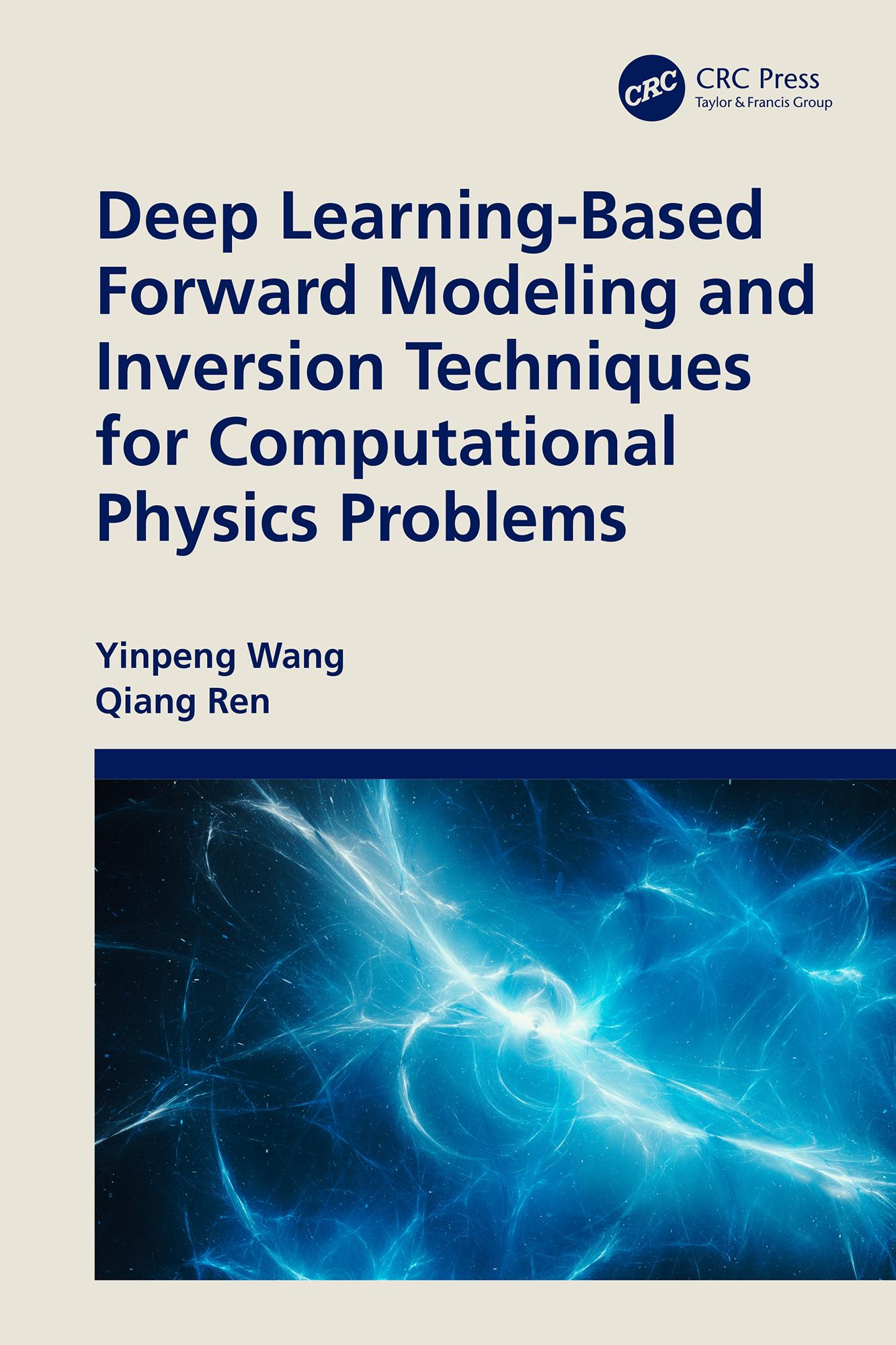
This book investigates in detail the emerging deep learning (DL) technique in computational physics, assessing its promising potential to substitute conventional numerical solvers for calculating the fields in real-time. After good training, the proposed architecture can resolve both the forward computing and the inverse retrieve problems.
Pursuing a holistic perspective, the book includes the following areas. The first chapter discusses the basic DL frameworks. Then, the steady heat conduction problem is solved by the classical U-net in Chapter 2, involving both the passive and active cases. Afterwards, the sophisticated heat flux on a curved surface is reconstructed by the presented Conv-LSTM, exhibiting high accuracy and efficiency. Additionally, a physics-informed DL structure along with a nonlinear mapping module are employed to obtain the space/temperature/time-related thermal conductivity via the transient temperature in Chapter 4. Finally, in Chapter 5, a series of the latest advanced frameworks and the corresponding physics applications are introduced.
As deep learning techniques are experiencing vigorous development in computational physics, more people desire related reading materials. This book is intended for graduate students, professional practitioners, and researchers who are interested in DL for computational physics.
Płać wygodnie kartą, Klarną, Apple Pay lub Google Pay. Nie jesteś zadowolony? Zawsze masz 14-dniową gwarancję zwrotu pieniędzy. Więcej przeczytasz w naszych warunkach. Masz pytania? Napisz do nas na hello@memmo.org.
Memmo ułatwia naukę – gdziekolwiek jesteś na świecie. U nas znajdziesz podręczniki i sprytne narzędzia do nauki w jednym miejscu: streszczenia, quizy, podcasty i fiszki. A do tego Ted, Twój kumpel do nauki, który odpowie na wszystko, co Cię nurtuje. Ponad 50 000 studentów już tu się uczy – stworzone, byś uczył się szybciej i mniej stresował.