
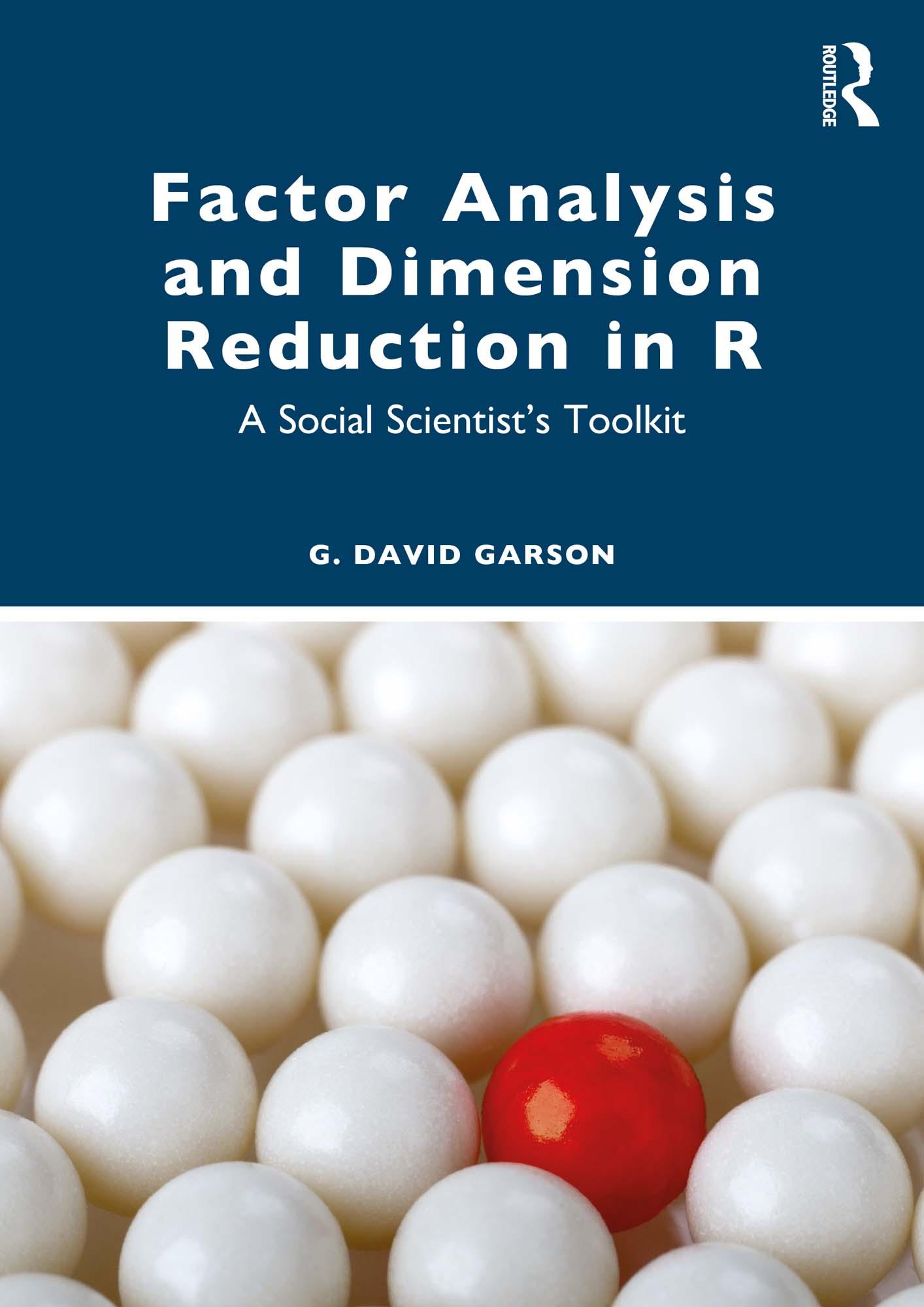
Factor Analysis and Dimension Reduction in R provides coverage, with worked examples, of a large number of dimension reduction procedures along with model performance metrics to compare them. Factor analysis in the form of principal components analysis (PCA) or principal factor analysis (PFA) is familiar to most social scientists. However, what is less familiar is understanding that factor analysis is a subset of the more general statistical family of dimension reduction methods.
The social scientist's toolkit for factor analysis problems can be expanded to include the range of solutions this book presents. In addition to covering FA and PCA with orthogonal and oblique rotation, this book’s coverage includes higher-order factor models, bifactor models, models based on binary and ordinal data, models based on mixed data, generalized low-rank models, cluster analysis with GLRM, models involving supplemental variables or observations, Bayesian factor analysis, regularized factor analysis, testing for unidimensionality, and prediction with factor scores. The second half of the book deals with other procedures for dimension reduction. These include coverage of kernel PCA, factor analysis with multidimensional scaling, locally linear embedding models, Laplacian eigenmaps, diffusion maps, force directed methods, t-distributed stochastic neighbor embedding, independent component analysis (ICA), dimensionality reduction via regression (DRR), non-negative matrix factorization (NNMF), Isomap, Autoencoder, uniform manifold approximation and projection (UMAP) models, neural network models, and longitudinal factor analysis models. In addition, a special chapter covers metrics for comparing model performance.
Features of this book include:
- Numerous worked examples with replicable R code
- Explicit comprehensive coverage of data assumptions
- Adaptation of factor methods to binary, ordinal, and categorical data
- Residual and outlier analysis
- Visualization of factor results
- Final chapters that treat integration of factor analysis with neural network and time series methods
Presented in color with R code and introduction to R and RStudio, this book will be suitable for graduate-level and optional module courses for social scientists, and on quantitative methods and multivariate statistics courses.
Płać wygodnie kartą, Klarną, Apple Pay lub Google Pay. Nie jesteś zadowolony? Zawsze masz 14-dniową gwarancję zwrotu pieniędzy. Więcej przeczytasz w naszych warunkach. Masz pytania? Napisz do nas na hello@memmo.org.
Memmo ułatwia naukę – gdziekolwiek jesteś na świecie. U nas znajdziesz podręczniki i sprytne narzędzia do nauki w jednym miejscu: streszczenia, quizy, podcasty i fiszki. A do tego Ted, Twój kumpel do nauki, który odpowie na wszystko, co Cię nurtuje. Ponad 50 000 studentów już tu się uczy – stworzone, byś uczył się szybciej i mniej stresował.