
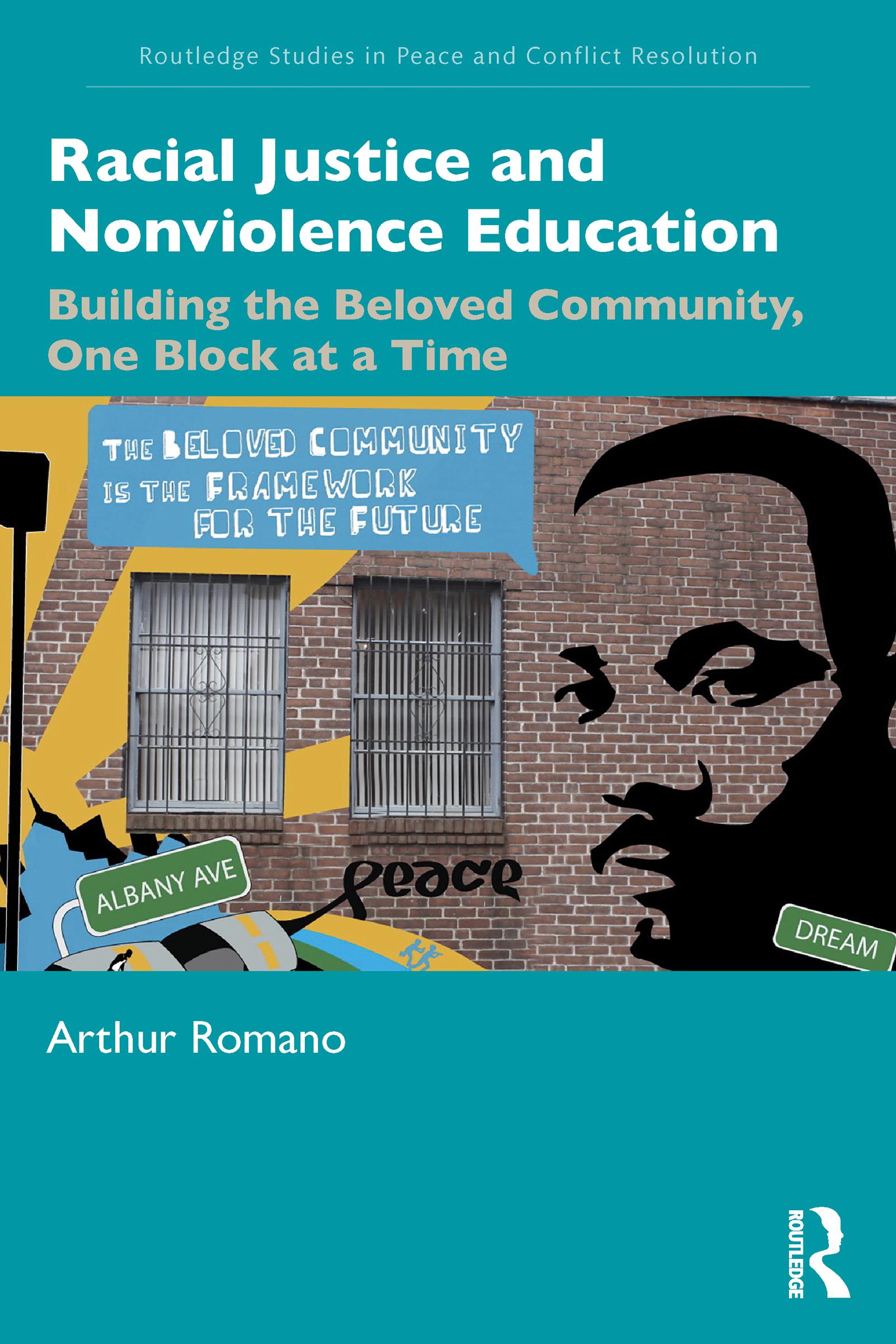
This book examines the role that community-based educators in violence-affected cities play in advancing Dr. Martin Luther King Jr.’s radical nonviolent vision for racial and social justice.
This work argues that nonviolence education can help communities build capacity to disrupt and transform cycles of violence by recognizing that people impacted by violence are effective educators and vital knowledge producers who develop unique insights into racial oppression and other forms of systemic harm. This book focuses on informal education that takes place beyond school walls, a type of education that too often remains invisible and undervalued in both civil society and scholarly research. It draws on thousands of hours of work with the Connecticut Center for Nonviolence (CTCN), a grassroots organization that presents an ideal case study of the implementation of King’s core principles of nonviolence in 21st-century urban communities. Stories of educators’ life-changing educational encounters, their successes and failures, and their understanding of the six principles of Kingian nonviolence animate the text. Each chapter delves into one of the six principles by introducing the reader to the lives of these educators, providing a rich analysis of how educators teach each principle, and sharing academic resources for thinking more deeply about each principle. Against the backdrop of today’s educational system, in which reductive and caricatured treatments of King are often presented within the formal classroom, CTCN’s work outside of the classroom takes a fundamentally different approach, connecting King’s thinking around nonviolence principles to working for racial justice in cities deeply impacted by violence.
This book will be of much interest to students of conflict resolution, race studies, politics and education studies, as well as to practitioners in the field.
Płać wygodnie kartą, Klarną, Apple Pay lub Google Pay. Nie jesteś zadowolony? Zawsze masz 14-dniową gwarancję zwrotu pieniędzy. Więcej przeczytasz w naszych warunkach. Masz pytania? Napisz do nas na hello@memmo.org.
Memmo ułatwia naukę – gdziekolwiek jesteś na świecie. U nas znajdziesz podręczniki i sprytne narzędzia do nauki w jednym miejscu: streszczenia, quizy, podcasty i fiszki. A do tego Ted, Twój kumpel do nauki, który odpowie na wszystko, co Cię nurtuje. Ponad 50 000 studentów już tu się uczy – stworzone, byś uczył się szybciej i mniej stresował.