
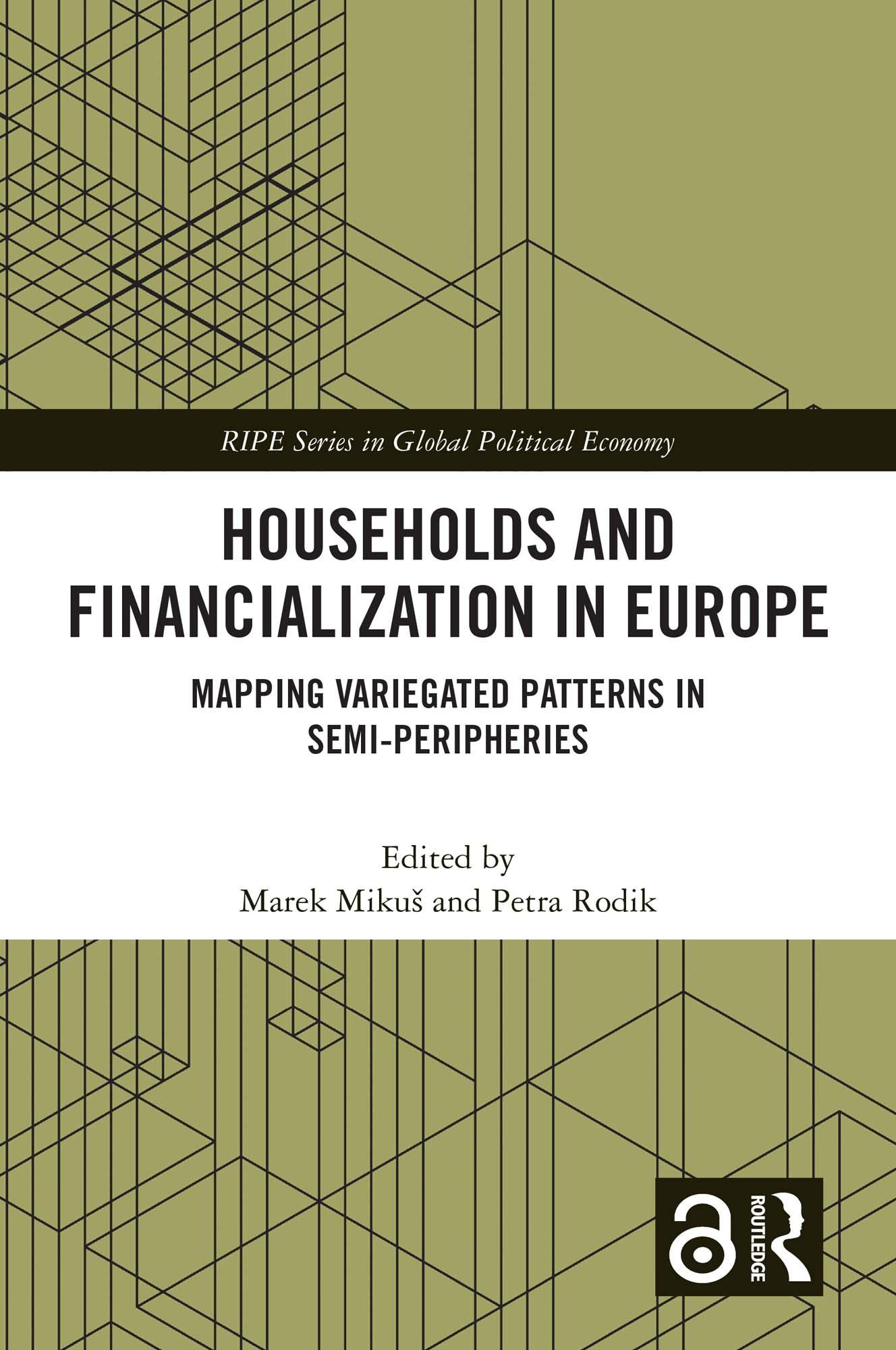
Households and Financialization in Europe develops a processual, relational and critical transdisciplinary approach to household financialization in Europe, utilizing a range of national and local case studies. It does so by drawing on debates in Marxist, feminist and radical IPE, anthropology and other fields.
The book explores the household as simultaneously a micro-level social institution specializing in social reproduction, distribution and other activities; a building bloc of larger economic and social structures; and an object of multiple systems of power/knowledge. Putting this conceptualization to use in original research, the authors identify geographically and historically situated ways in which financialization transforms households and their relationships with the wider economy and society. The book traces these transformations in case studies of variegated financialization in Eastern and Southern European (semi-) peripheries where households have faced particularly severe financial issues since the global financial crisis, such as over-indebtedness and asset devaluation. Key themes recurring throughout the book include: the key role of housing in household financialization, the co-constitutive relationship between financialization and social and spatial inequalities, specific patterns in the relations of financial actors and households in semi-peripheries, and the implications of semi-peripheral forms of real and financial accumulation for household financialization.
With its transdisciplinary approach, this book will be of great interest to students and scholars of finance, financialization, household economics, international and global political economy, uneven development, economic anthropology, and economic sociology.
The Introduction of this book is freely available as a downloadable Open Access PDF at http://www.taylorfrancis.com under a Creative Commons Attribution CC-BY 4.0 license.
Płać wygodnie kartą, Klarną, Apple Pay lub Google Pay. Nie jesteś zadowolony? Zawsze masz 14-dniową gwarancję zwrotu pieniędzy. Więcej przeczytasz w naszych warunkach. Masz pytania? Napisz do nas na hello@memmo.org.
Memmo ułatwia naukę – gdziekolwiek jesteś na świecie. U nas znajdziesz podręczniki i sprytne narzędzia do nauki w jednym miejscu: streszczenia, quizy, podcasty i fiszki. A do tego Ted, Twój kumpel do nauki, który odpowie na wszystko, co Cię nurtuje. Ponad 50 000 studentów już tu się uczy – stworzone, byś uczył się szybciej i mniej stresował.