
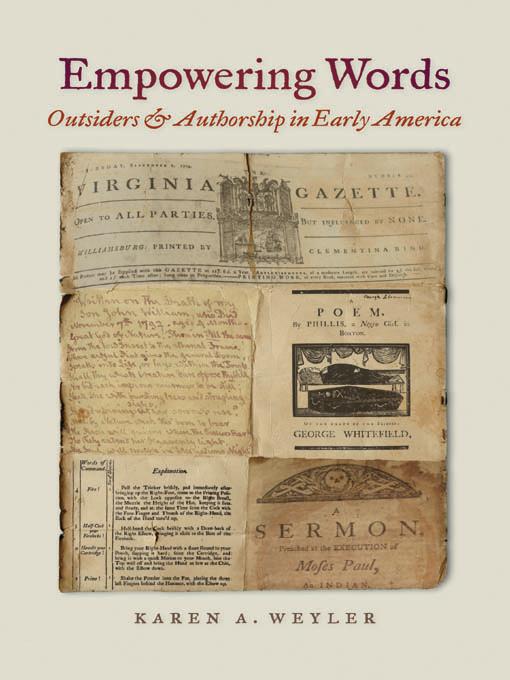
Standing outside elite or even middling circles, outsiders who were marginalized by limitations on their freedom and their need to labor for a living had a unique grasp on the profoundly social nature of print and its power to influence public opinion. In Empowering Words, Karen A. Weyler explores how outsiders used ephemeral formats such as broadsides, pamphlets, and newspapers to publish poetry, captivity narratives, formal addresses, and other genres with wide appeal in early America.
To gain access to print, outsiders collaborated with amanuenses and editors, inserted their stories into popular genres and cheap media, tapped into existing social and religious networks, and sought sponsors and patrons. They wrote individually, collaboratively, and even corporately, but writing for them was almost always an act of connection. Disparate levels of literacy did not necessarily entail subordination on the part of the lessliterate collaborator. Even the minimally literate and the illiterate understood the potential for print to be life changing, and outsiders shrewdly employed strategies to assert themselves within collaborative dynamics.
Empowering Words covers an array of outsiders including artisans; the minimally literate; the poor, indentured, or enslaved; and racial minorities. By focusing not only on New England, the traditional stronghold of early American literacy, but also on southern towns such as Williamsburg and Charleston, Weyler limns a more expansive map of early American authorship.
Płać wygodnie kartą, Klarną, Apple Pay lub Google Pay. Nie jesteś zadowolony? Zawsze masz 14-dniową gwarancję zwrotu pieniędzy. Więcej przeczytasz w naszych warunkach. Masz pytania? Napisz do nas na hello@memmo.org.
Memmo ułatwia naukę – gdziekolwiek jesteś na świecie. U nas znajdziesz podręczniki i sprytne narzędzia do nauki w jednym miejscu: streszczenia, quizy, podcasty i fiszki. A do tego Ted, Twój kumpel do nauki, który odpowie na wszystko, co Cię nurtuje. Ponad 50 000 studentów już tu się uczy – stworzone, byś uczył się szybciej i mniej stresował.