
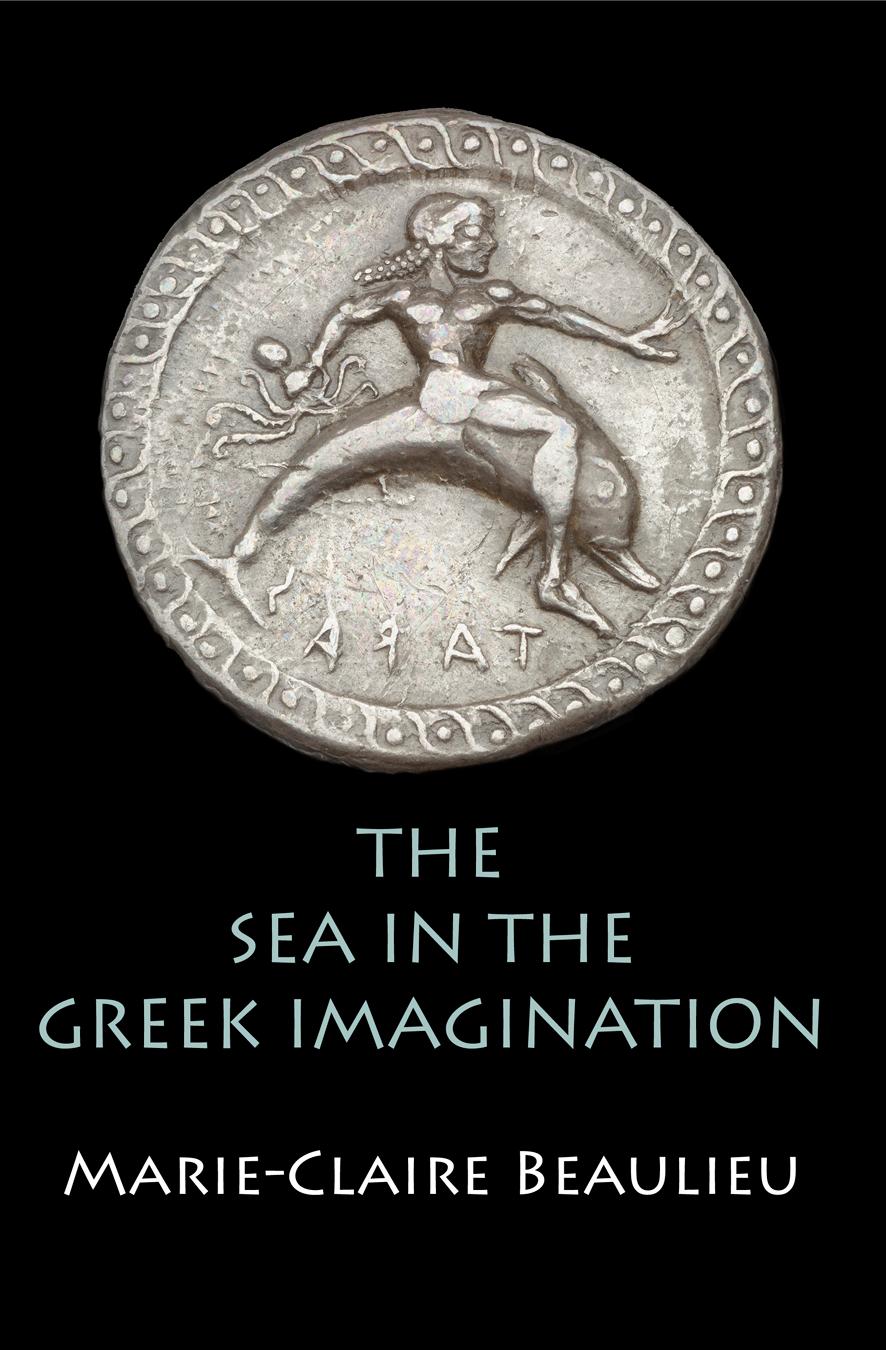
The sea is omnipresent in Greek life. Visible from nearly everywhere, the sea represents the life and livelihood of many who dwell on the islands and coastal areas of the Mediterranean, and it has been so since long ago—the sea loomed large in the Homeric epics and throughout Greek mythology. The Greeks of antiquity turned to the sea for food and for transport; for war, commerce, and scientific advancement; and for religious purification and other rites. Yet, the sea was simultaneously the center of Greek life and its limit. For, while the sea was a giver of much, it also embodied danger and uncertainty. It was in turns barren and fertile, and pictured as both a roadway and a terrifying void. The image of the sea in Greek myth is as conflicting as it is common, with sea crossings taking on seemingly incompatible meanings in different circumstances.
In The Sea in the Greek Imagination, Marie-Claire Beaulieu unifies the multifarious representations of the sea and sea crossings in Greek myth and imagery by positing the sea as a cosmological boundary between the mortal world, the underworld, and the realms of the immortal. Through six in-depth case studies, she shows how, more than a simple physical boundary, the sea represented the buffer zone between the imaginary and the real, the transitional space between the worlds of the living, the dead, and the gods. From dolphin riders to Dionysus, maidens to mermen, Beaulieu investigates the role of the sea in Greek myth in a broad-ranging and innovative study.
Płać wygodnie kartą, Klarną, Apple Pay lub Google Pay. Nie jesteś zadowolony? Zawsze masz 14-dniową gwarancję zwrotu pieniędzy. Więcej przeczytasz w naszych warunkach. Masz pytania? Napisz do nas na hello@memmo.org.
Memmo ułatwia naukę – gdziekolwiek jesteś na świecie. U nas znajdziesz podręczniki i sprytne narzędzia do nauki w jednym miejscu: streszczenia, quizy, podcasty i fiszki. A do tego Ted, Twój kumpel do nauki, który odpowie na wszystko, co Cię nurtuje. Ponad 50 000 studentów już tu się uczy – stworzone, byś uczył się szybciej i mniej stresował.