
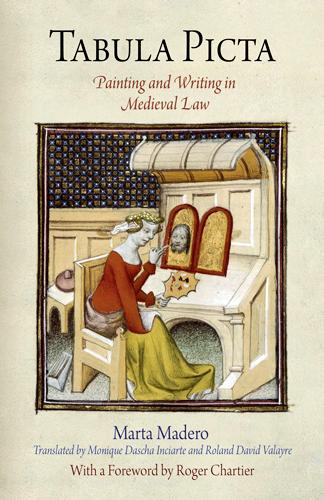
To whom does a painted tablet—a tabula picta—belong? To the owner of the physical piece of wood on which an image is painted? Or to the person who made the painting on that piece of wood? By extension, one might ask, who is the owner of a text? Is it the person who has written the words, or the individual who possesses the piece of parchment or slab of stone on which those words are inscribed?
In Tabula Picta Marta Madero turns to the extensive glosses and commentaries that medieval jurists dedicated to the above questions when articulating a notion of intellectual and artistic property radically different from our own. The most important goal for these legal thinkers, Madero argues, was to situate things—whatever they might be—within a logical framework that would allow for their description, categorization, and placement within a proper hierarchical order. Only juridical reasoning, they claimed, was capable of sorting out the individual elements that nature or human art had brought together in a single unit; by establishing sets of distinctions and taxonomies worthy of Borges, legal discourse sought to demonstrate that behind the deceptive immediacy of things, lie the concepts and arguments of what one might call the artifices of the concrete.
Płać wygodnie kartą, Klarną, Apple Pay lub Google Pay. Nie jesteś zadowolony? Zawsze masz 14-dniową gwarancję zwrotu pieniędzy. Więcej przeczytasz w naszych warunkach. Masz pytania? Napisz do nas na hello@memmo.org.
Memmo ułatwia naukę – gdziekolwiek jesteś na świecie. U nas znajdziesz podręczniki i sprytne narzędzia do nauki w jednym miejscu: streszczenia, quizy, podcasty i fiszki. A do tego Ted, Twój kumpel do nauki, który odpowie na wszystko, co Cię nurtuje. Ponad 50 000 studentów już tu się uczy – stworzone, byś uczył się szybciej i mniej stresował.