
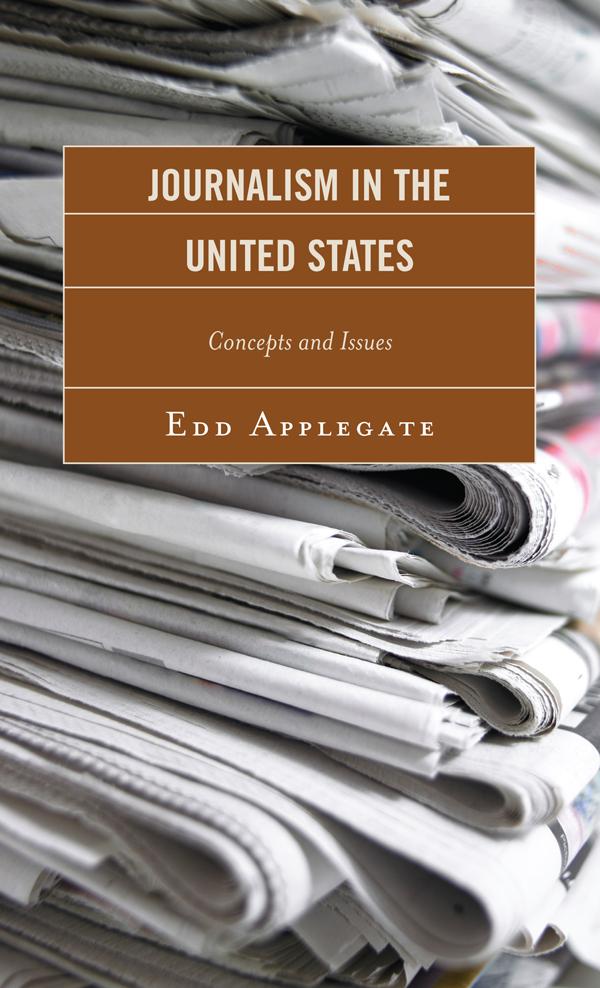
"Print and broadcast journalism in the United States have changed in recent years as a result of millions of people using the Internet and social media for obtaining some or most of the information they desire." So notes professor of journalism Edd Applegate, who, after surveying the decline in circulation and advertising revenues of newspapers and broadcast and radio news stations and the rise of cable news and website journalism, outlines in Journalism in the United States: Concepts and Issues the effect of this sea of change on key matters in journalism today.
In this work, Applegate updates readers on the current conditions of the print and broadcast industries with chapters on a variety of topics, from theories of the press to the structure of the print and broadcast industries, from the role of advertising and public relations to the role of the changing view of the press' views of and commitments to objectivity and "news balance." Throughout, Applegate obliges readers to wrestle with how the change in medium, from print or broadcast to Web, is not the main culprit in how the news has changed. Instead, he illustrates how many of the core issues remain unchanged and what is needed is a more complex analysis of core concepts and issues and how these have been affected-from freedom of the press to the treatment of minorities-by the evolution of news as a business and the education of journalists today for that business.
With a selected bibliography and an index to assist the reader, this book is a wonderful text for upper-level undergraduates, graduates, and college faculty with journalism or mass communications courses, as well as for academic libraries.
In this work, Applegate updates readers on the current conditions of the print and broadcast industries with chapters on a variety of topics, from theories of the press to the structure of the print and broadcast industries, from the role of advertising and public relations to the role of the changing view of the press' views of and commitments to objectivity and "news balance." Throughout, Applegate obliges readers to wrestle with how the change in medium, from print or broadcast to Web, is not the main culprit in how the news has changed. Instead, he illustrates how many of the core issues remain unchanged and what is needed is a more complex analysis of core concepts and issues and how these have been affected-from freedom of the press to the treatment of minorities-by the evolution of news as a business and the education of journalists today for that business.
With a selected bibliography and an index to assist the reader, this book is a wonderful text for upper-level undergraduates, graduates, and college faculty with journalism or mass communications courses, as well as for academic libraries.
Płać wygodnie kartą, Klarną, Apple Pay lub Google Pay. Nie jesteś zadowolony? Zawsze masz 14-dniową gwarancję zwrotu pieniędzy. Więcej przeczytasz w naszych warunkach. Masz pytania? Napisz do nas na hello@memmo.org.
Memmo ułatwia naukę – gdziekolwiek jesteś na świecie. U nas znajdziesz podręczniki i sprytne narzędzia do nauki w jednym miejscu: streszczenia, quizy, podcasty i fiszki. A do tego Ted, Twój kumpel do nauki, który odpowie na wszystko, co Cię nurtuje. Ponad 50 000 studentów już tu się uczy – stworzone, byś uczył się szybciej i mniej stresował.