
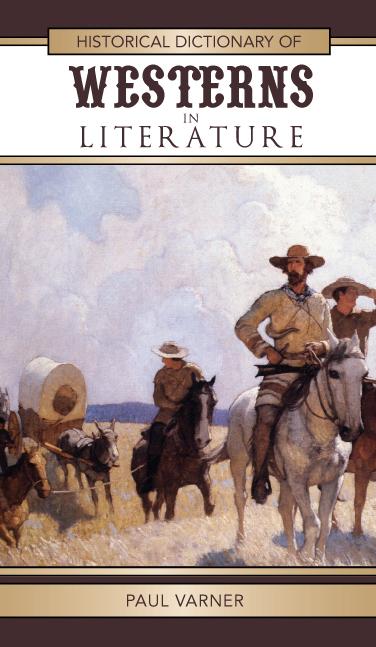
When in 1902 Owen Wister, a member of the Eastern blueblood aristocracy and friend of novelist Henry James, became a best-selling novelist with the publication of The Virginian, few readers would have guessed that a new kind of American literature was being born. While Owen Wister was enjoying his success, Edwin S. Porter in New Jersey was filming the first cinema Western The Great Train Robbery, which would usher in a new era both of movies in general and of Western movies in particular. Both events would lead to a century of cultural fascination with stories of the old West.
The Historical Dictionary of Westerns in Literature tells the story of the Western through a chronology, a bibliography, an introductory essay, and hundreds of cross-referenced dictionary entries on authors such as Owen Wister, Zane Grey, Max Brand, Clarence Mulford, Ernest Haycox, Luke Short, Dorothy Johnson, Louis L'Amour, and Cormac McCarthy.
The Historical Dictionary of Westerns in Literature tells the story of the Western through a chronology, a bibliography, an introductory essay, and hundreds of cross-referenced dictionary entries on authors such as Owen Wister, Zane Grey, Max Brand, Clarence Mulford, Ernest Haycox, Luke Short, Dorothy Johnson, Louis L'Amour, and Cormac McCarthy.
Płać wygodnie kartą, Klarną, Apple Pay lub Google Pay. Nie jesteś zadowolony? Zawsze masz 14-dniową gwarancję zwrotu pieniędzy. Więcej przeczytasz w naszych warunkach. Masz pytania? Napisz do nas na hello@memmo.org.
Memmo ułatwia naukę – gdziekolwiek jesteś na świecie. U nas znajdziesz podręczniki i sprytne narzędzia do nauki w jednym miejscu: streszczenia, quizy, podcasty i fiszki. A do tego Ted, Twój kumpel do nauki, który odpowie na wszystko, co Cię nurtuje. Ponad 50 000 studentów już tu się uczy – stworzone, byś uczył się szybciej i mniej stresował.