
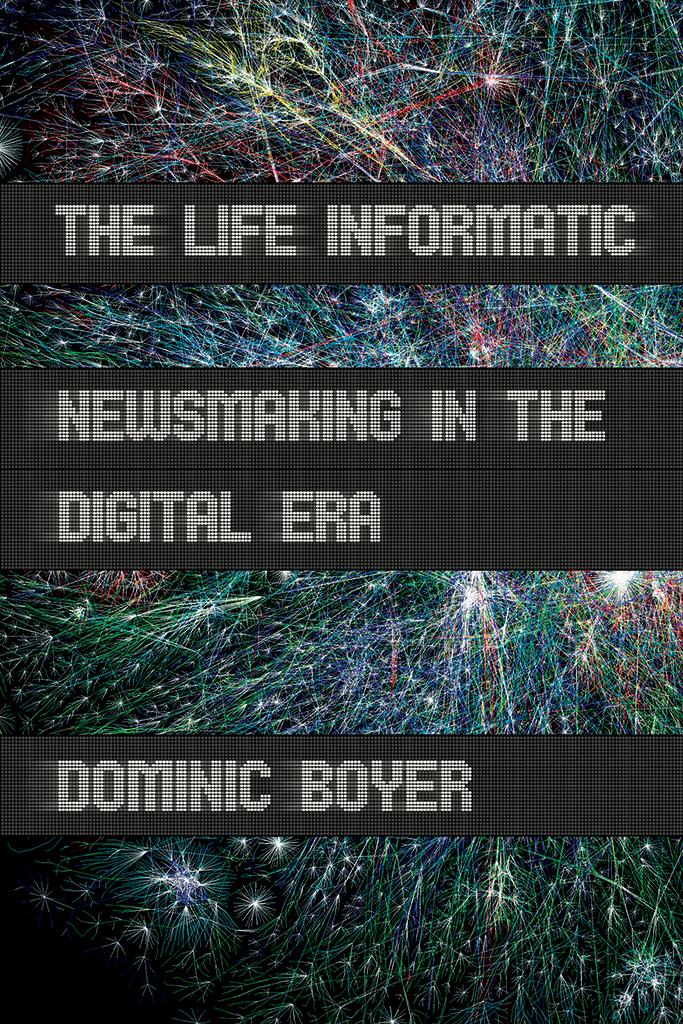
News journalism is in the midst of radical transformation brought about by the spread of digital information and communication technology and the rise of neoliberalism. What does it look like, however, from the inside of a news organization? In The Life Informatic, Dominic Boyer offers the first anthropological ethnography of contemporary office-based news journalism. The result is a fascinating account of journalists struggling to maintain their expertise and authority, even as they find their principles and skills profoundly challenged by ever more complex and fast-moving streams of information.
Boyer conducted his fieldwork inside three news organizations in Germany (a world leader in digital journalism) supplemented by extensive interviews in the United States. His findings challenge popular and scholarly images of journalists as roving truth-seekers, showing instead the extent to which sedentary office-based "screenwork" (such as gathering and processing information online) has come to dominate news journalism. To explain this phenomenon Boyer puts forth the notion of "digital liberalism"—a powerful convergence of technological and ideological forces over the past two decades that has rebalanced electronic mediation from the radial (or broadcast) tendencies of the mid-twentieth century to the lateral (or peer-to-peer) tendencies that dominate in the era of the Internet and social media. Under digital liberalism an entire regime of media, knowledge, and authority has become integrated around liberal principles of individuality and publicity, both unmaking and remaking news institutions of the broadcast era. Finally, Boyer offers some scenarios for how news journalism will develop in the future and discusses how other intellectual professionals, such as ethnographers, have also become more screenworkers than fieldworkers.
Płać wygodnie kartą, Klarną, Apple Pay lub Google Pay. Nie jesteś zadowolony? Zawsze masz 14-dniową gwarancję zwrotu pieniędzy. Więcej przeczytasz w naszych warunkach. Masz pytania? Napisz do nas na hello@memmo.org.
Memmo ułatwia naukę – gdziekolwiek jesteś na świecie. U nas znajdziesz podręczniki i sprytne narzędzia do nauki w jednym miejscu: streszczenia, quizy, podcasty i fiszki. A do tego Ted, Twój kumpel do nauki, który odpowie na wszystko, co Cię nurtuje. Ponad 50 000 studentów już tu się uczy – stworzone, byś uczył się szybciej i mniej stresował.