
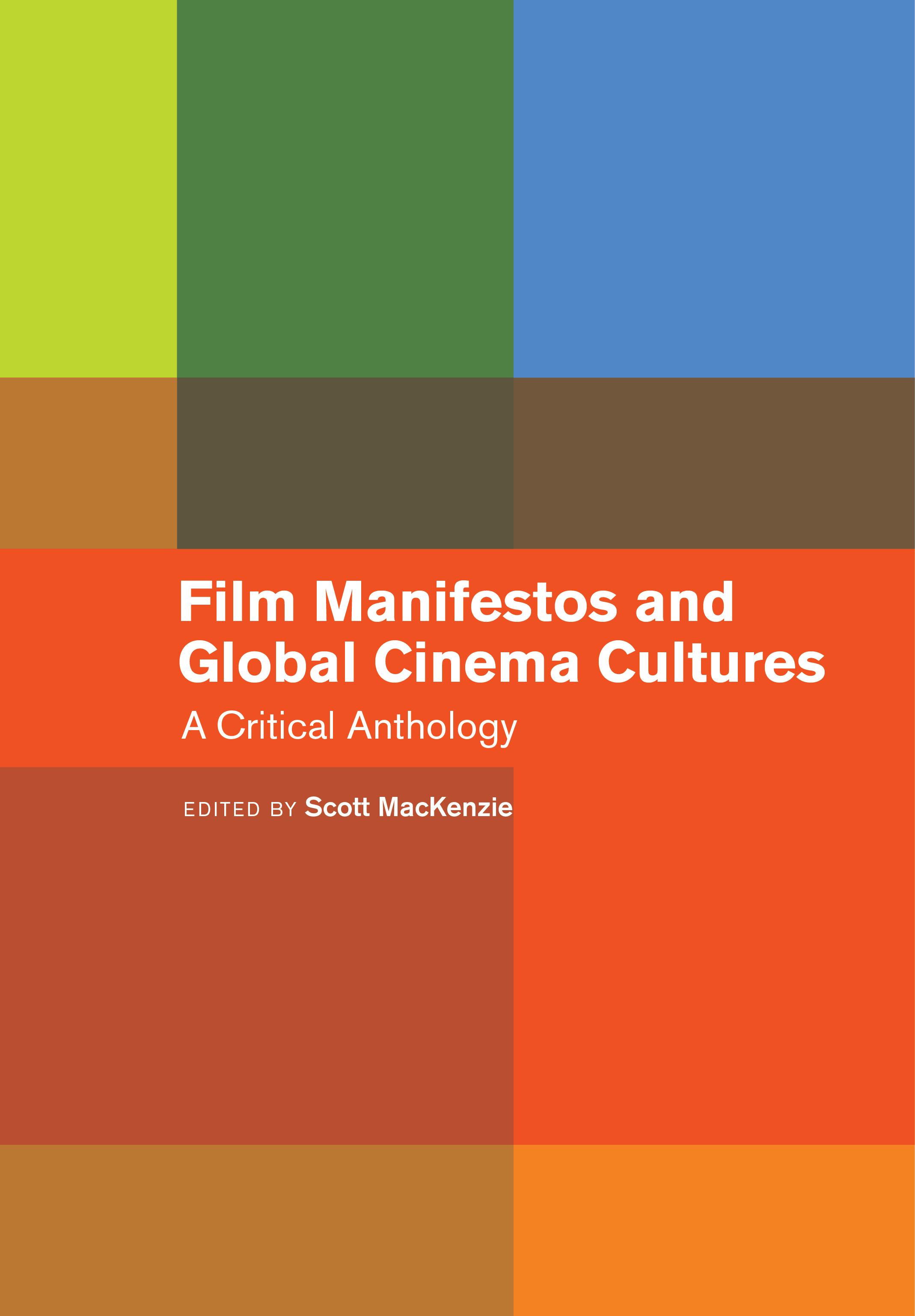
Film Manifestos and Global Cinema Cultures is the first book to collect manifestoes from the global history of cinema, providing the first historical and theoretical account of the role played by film manifestos in filmmaking and film culture. Focusing equally on political and aesthetic manifestoes, Scott MacKenzie uncovers a neglected, yet nevertheless central history of the cinema, exploring a series of documents that postulate ways in which to re-imagine the cinema and, in the process, re-imagine the world.
This volume collects the major European “waves” and figures (Eisenstein, Truffaut, Bergman, Free Cinema, Oberhausen, Dogme ‘95); Latin American Third Cinemas (Birri, Sanjinés, Espinosa, Solanas); radical art and the avant-garde (Buñuel, Brakhage, Deren, Mekas, Ono, Sanborn); and world cinemas (Iimura, Makhmalbaf, Sembene, Sen). It also contains previously untranslated manifestos co-written by figures including Bollaín, Debord, Hermosillo, Isou, Kieslowski, Painlevé, Straub, and many others. Thematic sections address documentary cinema, aesthetics, feminist and queer film cultures, pornography, film archives, Hollywood, and film and digital media. Also included are texts traditionally left out of the film manifestos canon, such as the Motion Picture Production Code and Pius XI's Vigilanti Cura, which nevertheless played a central role in film culture.
This volume collects the major European “waves” and figures (Eisenstein, Truffaut, Bergman, Free Cinema, Oberhausen, Dogme ‘95); Latin American Third Cinemas (Birri, Sanjinés, Espinosa, Solanas); radical art and the avant-garde (Buñuel, Brakhage, Deren, Mekas, Ono, Sanborn); and world cinemas (Iimura, Makhmalbaf, Sembene, Sen). It also contains previously untranslated manifestos co-written by figures including Bollaín, Debord, Hermosillo, Isou, Kieslowski, Painlevé, Straub, and many others. Thematic sections address documentary cinema, aesthetics, feminist and queer film cultures, pornography, film archives, Hollywood, and film and digital media. Also included are texts traditionally left out of the film manifestos canon, such as the Motion Picture Production Code and Pius XI's Vigilanti Cura, which nevertheless played a central role in film culture.
Płać wygodnie kartą, Klarną, Apple Pay lub Google Pay. Nie jesteś zadowolony? Zawsze masz 14-dniową gwarancję zwrotu pieniędzy. Więcej przeczytasz w naszych warunkach. Masz pytania? Napisz do nas na hello@memmo.org.
Memmo ułatwia naukę – gdziekolwiek jesteś na świecie. U nas znajdziesz podręczniki i sprytne narzędzia do nauki w jednym miejscu: streszczenia, quizy, podcasty i fiszki. A do tego Ted, Twój kumpel do nauki, który odpowie na wszystko, co Cię nurtuje. Ponad 50 000 studentów już tu się uczy – stworzone, byś uczył się szybciej i mniej stresował.
Może Ci się spodobać
Kup książkę0