
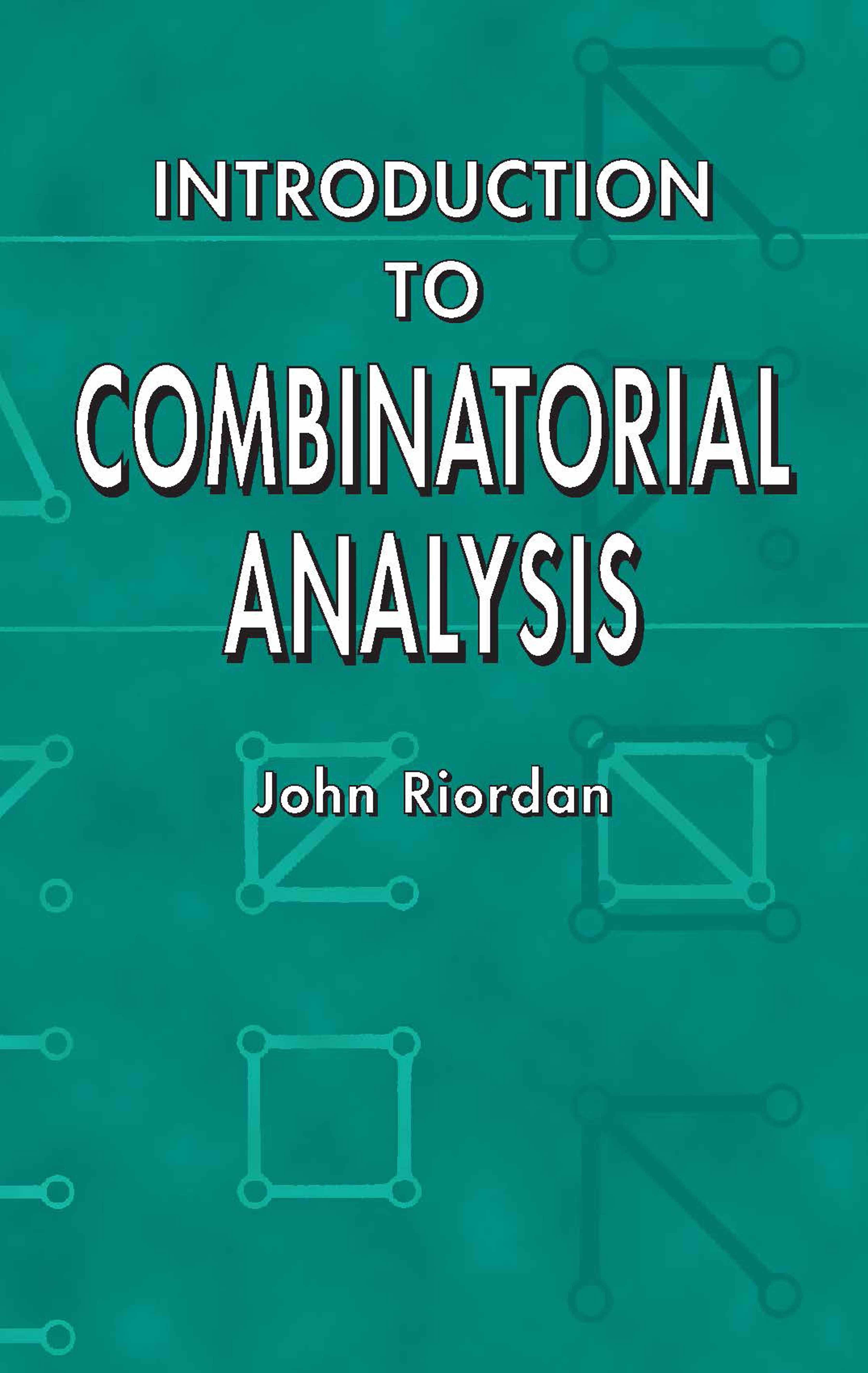
This introduction to combinatorial analysis defines the subject as "the number of ways there are of doing some well-defined operation." Chapter 1 surveys that part of the theory of permutations and combinations that finds a place in books on elementary algebra, which leads to the extended treatment of generation functions in Chapter 2, where an important result is the introduction of a set of multivariable polynomials.
Chapter 3 contains an extended treatment of the principle of inclusion and exclusion which is indispensable to the enumeration of permutations with restricted position given in Chapters 7 and 8. Chapter 4 examines the enumeration of permutations in cyclic representation and Chapter 5 surveys the theory of distributions. Chapter 6 considers partitions, compositions, and the enumeration of trees and linear graphs.
Each chapter includes a lengthy problem section, intended to develop the text and to aid the reader. These problems assume a certain amount of mathematical maturity. Equations, theorems, sections, examples, and problems are numbered consecutively in each chapter and are referred to by these numbers in other chapters.
Płać wygodnie kartą, Klarną, Apple Pay lub Google Pay. Nie jesteś zadowolony? Zawsze masz 14-dniową gwarancję zwrotu pieniędzy. Więcej przeczytasz w naszych warunkach. Masz pytania? Napisz do nas na hello@memmo.org.
Memmo ułatwia naukę – gdziekolwiek jesteś na świecie. U nas znajdziesz podręczniki i sprytne narzędzia do nauki w jednym miejscu: streszczenia, quizy, podcasty i fiszki. A do tego Ted, Twój kumpel do nauki, który odpowie na wszystko, co Cię nurtuje. Ponad 50 000 studentów już tu się uczy – stworzone, byś uczył się szybciej i mniej stresował.