
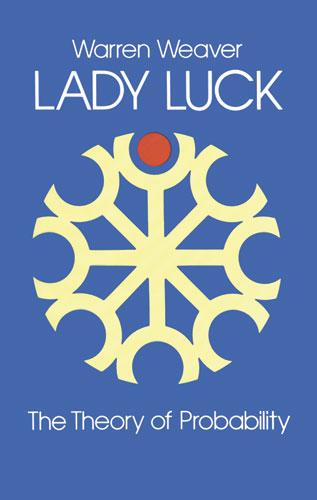
"Should I take my umbrella?" "Should I buy insurance?" "Which horse should I bet on?" Every day ― in business, in love affairs, in forecasting the weather or the stock market questions arise which cannot be answered by a simple "yes" or "no." Many of these questions involve probability. Probabilistic thinking is as crucially important in ordinary affairs as it is in the most abstruse realms of science.
This book is the best nontechnical introduction to probability ever written. Its author, the late Dr. Warren Weaver, was a professor of mathematics, active in the Rockefeller and Sloan foundations , an authority on communications and probability, and distinguished for his work at bridging the gap between science and the average citizen. In accessible language and drawing upon the widely diverse writings of thinkers like Kurt Godel, Susanne K.Langer, and Nicholas Bernoulli, Dr. Weaver explains such concepts as permutations, independent events, mathematical expectation, the law of averages, Chebychev's theorem, the law of large numbers, and probability distributions. He uses a probabilistic viewpoint to illuminate such matters as rare events and coincidences, and also devotes space to the relations of probability and statistics, gambling, and modern scientific research. Dr. Weaver writes with wit, charm and exceptional clarity. His mathematics is elementary, grasp of the subject profound, and examples fascinating. They are complemented by 49 delightful drawings by Peg Hosford. 13 tables. 49 drawings. Foreword. Index.
Płać wygodnie kartą, Klarną, Apple Pay lub Google Pay. Nie jesteś zadowolony? Zawsze masz 14-dniową gwarancję zwrotu pieniędzy. Więcej przeczytasz w naszych warunkach. Masz pytania? Napisz do nas na hello@memmo.org.
Memmo ułatwia naukę – gdziekolwiek jesteś na świecie. U nas znajdziesz podręczniki i sprytne narzędzia do nauki w jednym miejscu: streszczenia, quizy, podcasty i fiszki. A do tego Ted, Twój kumpel do nauki, który odpowie na wszystko, co Cię nurtuje. Ponad 50 000 studentów już tu się uczy – stworzone, byś uczył się szybciej i mniej stresował.