
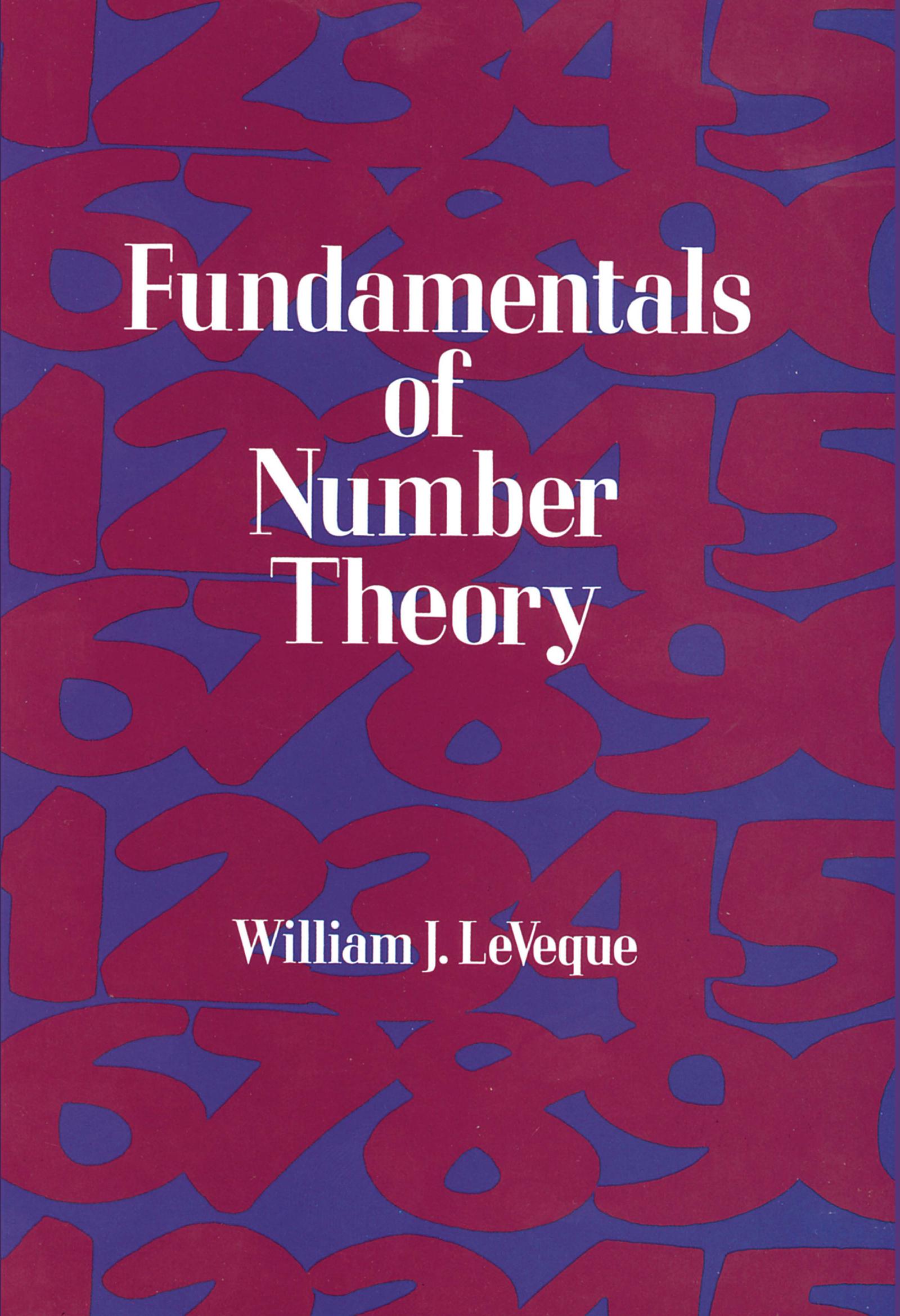
This excellent textbook introduces the basics of number theory, incorporating the language of abstract algebra. A knowledge of such algebraic concepts as group, ring, field, and domain is not assumed, however; all terms are defined and examples are given — making the book self-contained in this respect.
The author begins with an introductory chapter on number theory and its early history. Subsequent chapters deal with unique factorization and the GCD, quadratic residues, number-theoretic functions and the distribution of primes, sums of squares, quadratic equations and quadratic fields, diophantine approximation, and more. Included are discussions of topics not always found in introductory texts: factorization and primality of large integers, p-adic numbers, algebraic number fields, Brun's theorem on twin primes, and the transcendence of e, to mention a few.
Readers will find a substantial number of well-chosen problems, along with many notes and bibliographical references selected for readability and relevance. Five helpful appendixes — containing such study aids as a factor table, computer-plotted graphs, a table of indices, the Greek alphabet, and a list of symbols — and a bibliography round out this well-written text, which is directed toward undergraduate majors and beginning graduate students in mathematics. No post-calculus prerequisite is assumed. 1977 edition.
Płać wygodnie kartą, Klarną, Apple Pay lub Google Pay. Nie jesteś zadowolony? Zawsze masz 14-dniową gwarancję zwrotu pieniędzy. Więcej przeczytasz w naszych warunkach. Masz pytania? Napisz do nas na hello@memmo.org.
Memmo ułatwia naukę – gdziekolwiek jesteś na świecie. U nas znajdziesz podręczniki i sprytne narzędzia do nauki w jednym miejscu: streszczenia, quizy, podcasty i fiszki. A do tego Ted, Twój kumpel do nauki, który odpowie na wszystko, co Cię nurtuje. Ponad 50 000 studentów już tu się uczy – stworzone, byś uczył się szybciej i mniej stresował.