
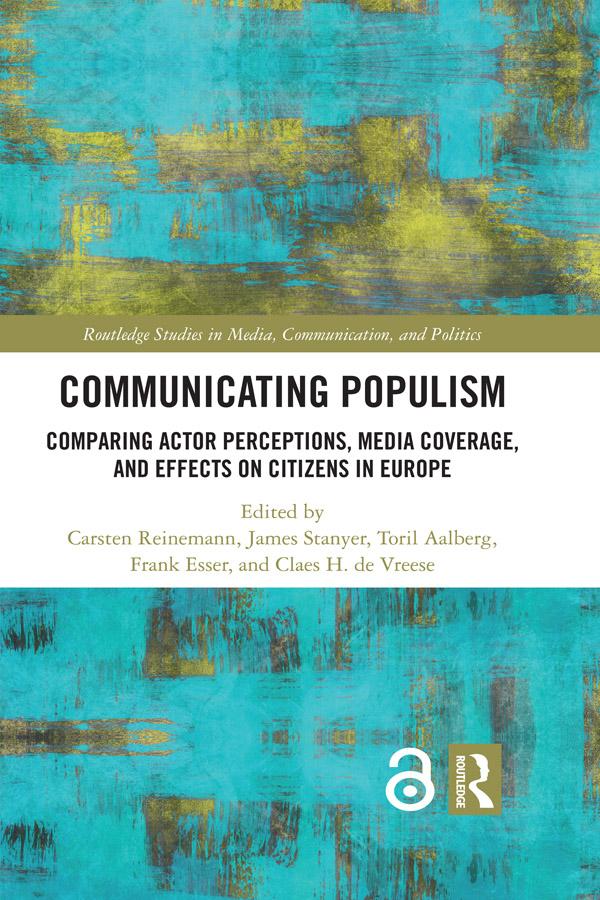
The studies in this volume conceptualize populism as a type of political communication and investigate it comparatively, focusing on (a) politicians’ and journalists’ perceptions, (b) media coverage, and (c) effects on citizens.
This book presents findings from several large-scale internationally comparative empirical studies, funded by the European Cooperation in the field of Scientific and Technical Research (COST), focusing on communication and the media within the context of populism and populist political communication in Europe. The studies are based on comparative interview studies with journalists and politicians, a large-scale comparative content analysis, and a comparative cross-country experiment using nationally representative online-surveys over 15 countries. The book also includes advice for stakeholders like politicians, the media, and citizens about how to deal with the challenge of populist political communication.
This enlightening volume is ‘populist’ in the best sense and will be an essential text for any scholar in political science, communication science, media studies, sociology and philosophy with an interest in populism and political communication. It does not assume specialist knowledge and will remain accessible and engaging to students, practitioners and policymakers.
Chapters 1 and 12 of this book are freely available as downloadable Open Access PDFs at http://www.taylorfrancis.com under a Creative Commons Attribution-Non Commercial-No Derivatives (CC-BY-NC-ND) 4.0 license.
Płać wygodnie kartą, Klarną, Apple Pay lub Google Pay. Nie jesteś zadowolony? Zawsze masz 14-dniową gwarancję zwrotu pieniędzy. Więcej przeczytasz w naszych warunkach. Masz pytania? Napisz do nas na hello@memmo.org.
Memmo ułatwia naukę – gdziekolwiek jesteś na świecie. U nas znajdziesz podręczniki i sprytne narzędzia do nauki w jednym miejscu: streszczenia, quizy, podcasty i fiszki. A do tego Ted, Twój kumpel do nauki, który odpowie na wszystko, co Cię nurtuje. Ponad 50 000 studentów już tu się uczy – stworzone, byś uczył się szybciej i mniej stresował.