
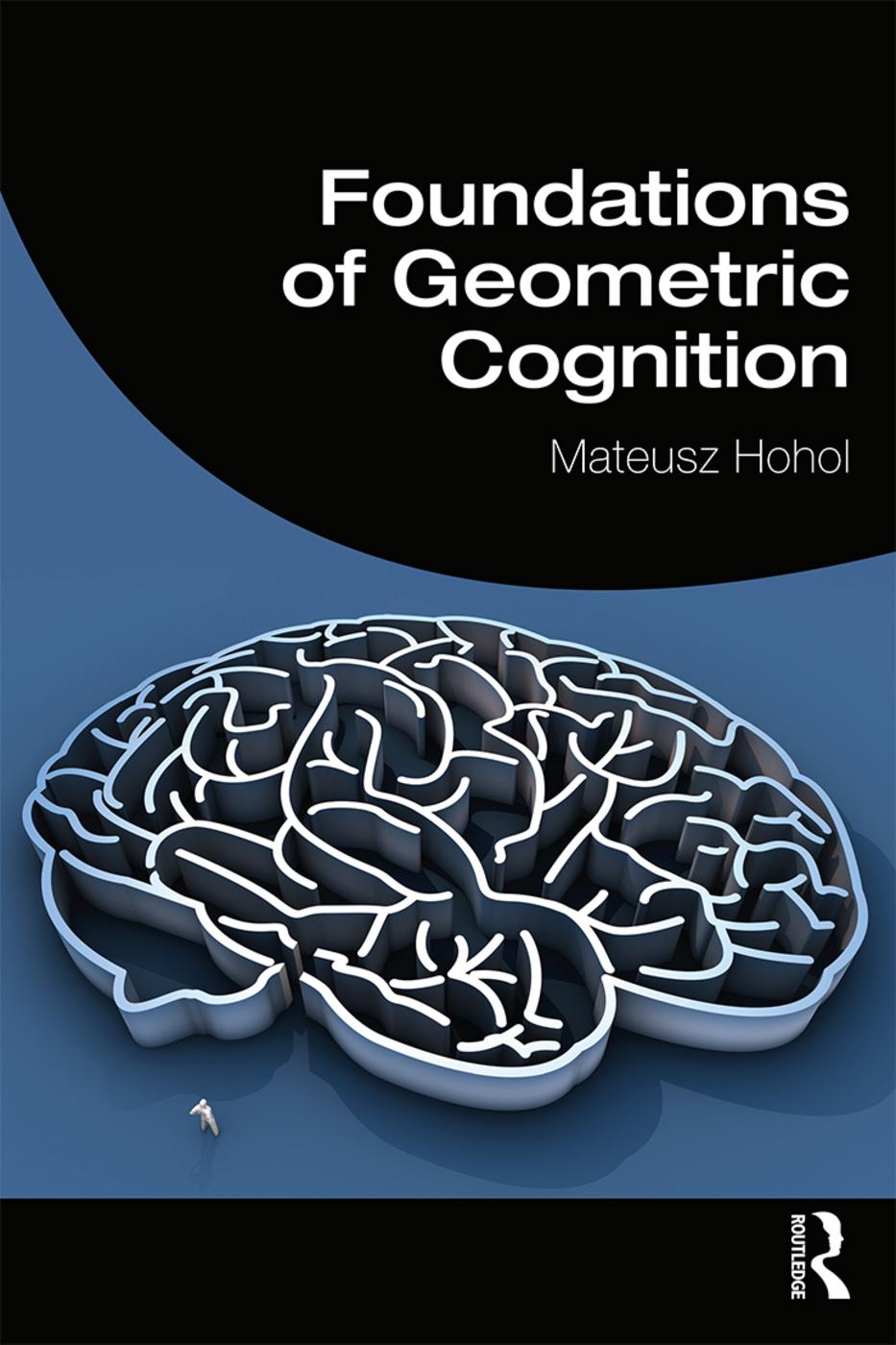
The cognitive foundations of geometry have puzzled academics for a long time, and even today are mostly unknown to many scholars, including mathematical cognition researchers.
Foundations of Geometric Cognition shows that basic geometric skills are deeply hardwired in the visuospatial cognitive capacities of our brains, namely spatial navigation and object recognition. These capacities, shared with non-human animals and appearing in early stages of the human ontogeny, cannot, however, fully explain a uniquely human form of geometric cognition. In the book, Hohol argues that Euclidean geometry would not be possible without the human capacity to create and use abstract concepts, demonstrating how language and diagrams provide cognitive scaffolding for abstract geometric thinking, within a context of a Euclidean system of thought.
Taking an interdisciplinary approach and drawing on research from diverse fields including psychology, cognitive science, and mathematics, this book is a must-read for cognitive psychologists and cognitive scientists of mathematics, alongside anyone interested in mathematical education or the philosophical and historical aspects of geometry.
Płać wygodnie kartą, Klarną, Apple Pay lub Google Pay. Nie jesteś zadowolony? Zawsze masz 14-dniową gwarancję zwrotu pieniędzy. Więcej przeczytasz w naszych warunkach. Masz pytania? Napisz do nas na hello@memmo.org.
Memmo ułatwia naukę – gdziekolwiek jesteś na świecie. U nas znajdziesz podręczniki i sprytne narzędzia do nauki w jednym miejscu: streszczenia, quizy, podcasty i fiszki. A do tego Ted, Twój kumpel do nauki, który odpowie na wszystko, co Cię nurtuje. Ponad 50 000 studentów już tu się uczy – stworzone, byś uczył się szybciej i mniej stresował.