
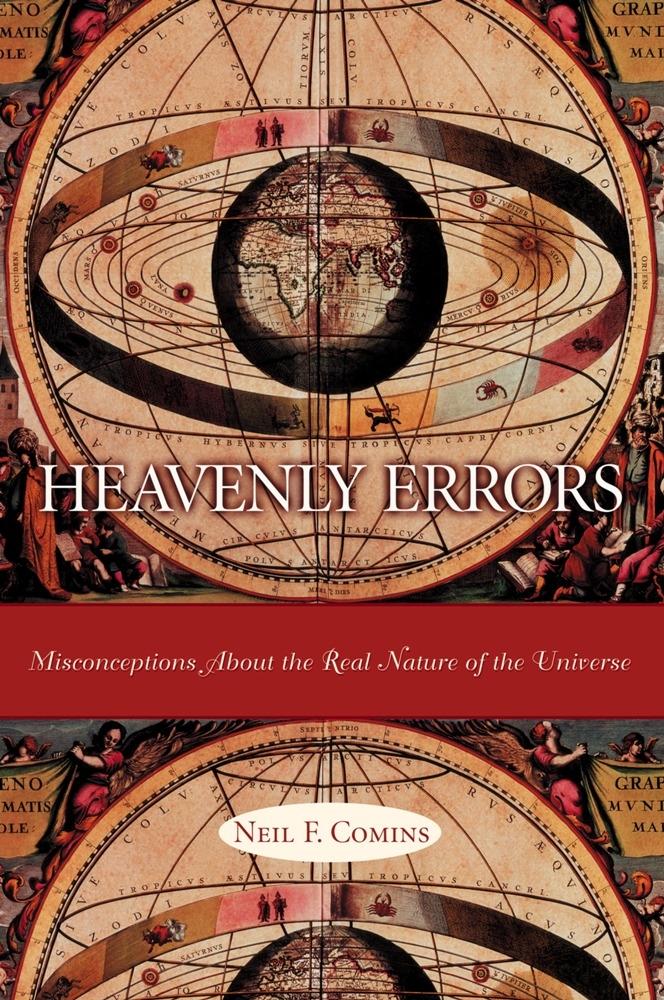
One of the great paradoxes of modern times is that the more scientists understand the natural world, the more we discover that our everyday beliefs about it are wrong. Astronomy, in particular, is one of the most misunderstood scientific disciplines.
With the participation of thousands of undergraduate students, Neil F. Comins has identified and classified, by origin and topic, over 1,700 commonly held misconceptions. Heavenly Errors provides access to all of them and explores many, including:
Black holes suck in everything around them.
The Sun shines by burning gas.
Comets have tails trailing behind them.
The Moon alone causes tides.
Mercury, the closest planet to the Sun, is the hottest planet.
In the course of correcting these errors, he explains that some occur through the prevalence of pseudosciences such as astrology and UFO-logy and some enter the public conscience through the "bad astronomy" of Star Trek, Star Wars, and other science-fiction movies.. Perhaps most important, Professor Comins presents the reader with the methods for identifying and replacing incorrect ideas—tools with which to probe erroneous notions so that we can begin to question for ourselves... and to think more like scientists.
Płać wygodnie kartą, Klarną, Apple Pay lub Google Pay. Nie jesteś zadowolony? Zawsze masz 14-dniową gwarancję zwrotu pieniędzy. Więcej przeczytasz w naszych warunkach. Masz pytania? Napisz do nas na hello@memmo.org.
Memmo ułatwia naukę – gdziekolwiek jesteś na świecie. U nas znajdziesz podręczniki i sprytne narzędzia do nauki w jednym miejscu: streszczenia, quizy, podcasty i fiszki. A do tego Ted, Twój kumpel do nauki, który odpowie na wszystko, co Cię nurtuje. Ponad 50 000 studentów już tu się uczy – stworzone, byś uczył się szybciej i mniej stresował.