
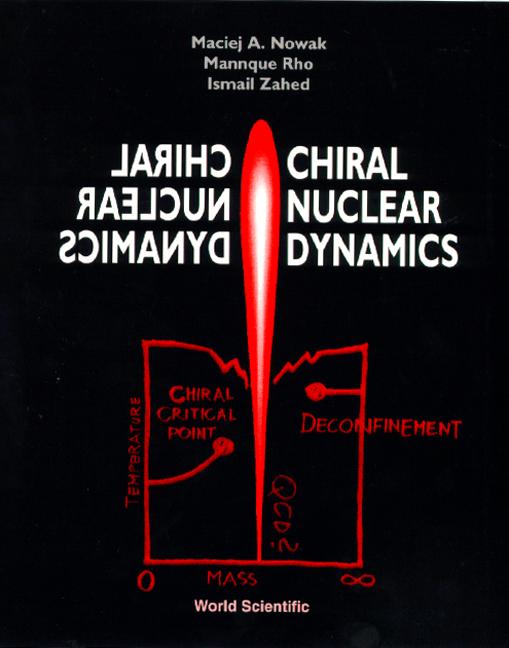
The physics of strongly interacting many-body systems known as nuclear physics is a mature discipline which has achieved a remarkably quantitative success. It has explained with an impressive accuracy the properties of nuclei from the deuteron to heavy nuclei containing several hundreds of nucleons. This is the more remarkable when one realizes that in no way did the success depend on the existence of, or knowledge derived from, the fundamental theory of strong interactions now believed to be quantum chromodynamics (QCD).This monograph is a first, albeit embryonic, attempt to explain how a nucleus can be understood without invoking the explicit degrees of freedom of quarks and gluons while still staying within the basic premise of QCD and furthermore why do quark-gluon signatures not show up prominently in nuclear processes, including those processes involving short-distance encounters within nuclei. Such an understanding is largely based on the modern concepts of broken chiral symmetry and is believed to be essential in uncovering new physics expected to figure in the hadronic environment under extreme conditions of high temperature and/or high density.
Betal enkelt med kort, Klarna, Apple Pay eller Google Pay. Ikke fornøyd? Du har alltid 14 dagers angrerett. Les mer i våre vilkår. Har du spørsmål, send oss en e-post på hello@memmo.org.
Memmo gjør det enklere å studere – uansett hvor du er i verden. Hos oss samler du pensumbøker og smarte studieverktøy på ett og samme sted: sammendrag, quizer, podkaster og flashcards. Og så Ted, din studiekompis som svarer på alt du lurer på. Over 50 000 studenter studerer allerede her – bygget for at du skal lære raskere og stresse mindre.
Du vil kanskje også like
Kjøp boken0