
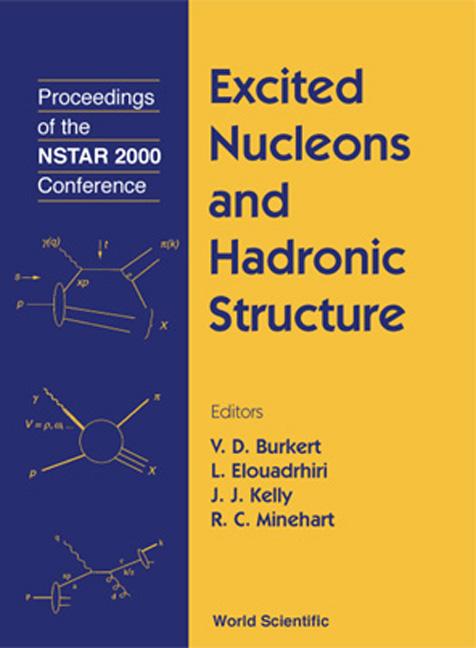
The conference NSTAR 2000 was part of a series of conferences and workshops that began in New York in 1988. Since then, the field of excited nucleons and hadron structure has developed enormously, and the scope has broadened. Most significantly, new experimental facilities have come into operation, allowing precise measurements of resonance couplings and transition form factors. The search for “missing” quark model states and gluonic excitations in complex hadronic channels is now possible.On the theory side, new and promising developments have emerged: quark models with meson degrees of freedom, hybrid baryon models, and studies of baryons in the limit of many colors. For the first time, lattice QCD has been employed to calculate masses of excited nucleons. Nucleon resonances are now recognized as providing significant contributions to the nucleon spin sum rules, as well as the Gerasimov-Drell-Hearn and Bjorken integrals, at finite momentum transfer.
Betal enkelt med kort, Klarna, Apple Pay eller Google Pay. Ikke fornøyd? Du har alltid 14 dagers angrerett. Les mer i våre vilkår. Har du spørsmål, send oss en e-post på hello@memmo.org.
Memmo gjør det enklere å studere – uansett hvor du er i verden. Hos oss samler du pensumbøker og smarte studieverktøy på ett og samme sted: sammendrag, quizer, podkaster og flashcards. Og så Ted, din studiekompis som svarer på alt du lurer på. Over 50 000 studenter studerer allerede her – bygget for at du skal lære raskere og stresse mindre.
Du vil kanskje også like
Kjøp boken0