
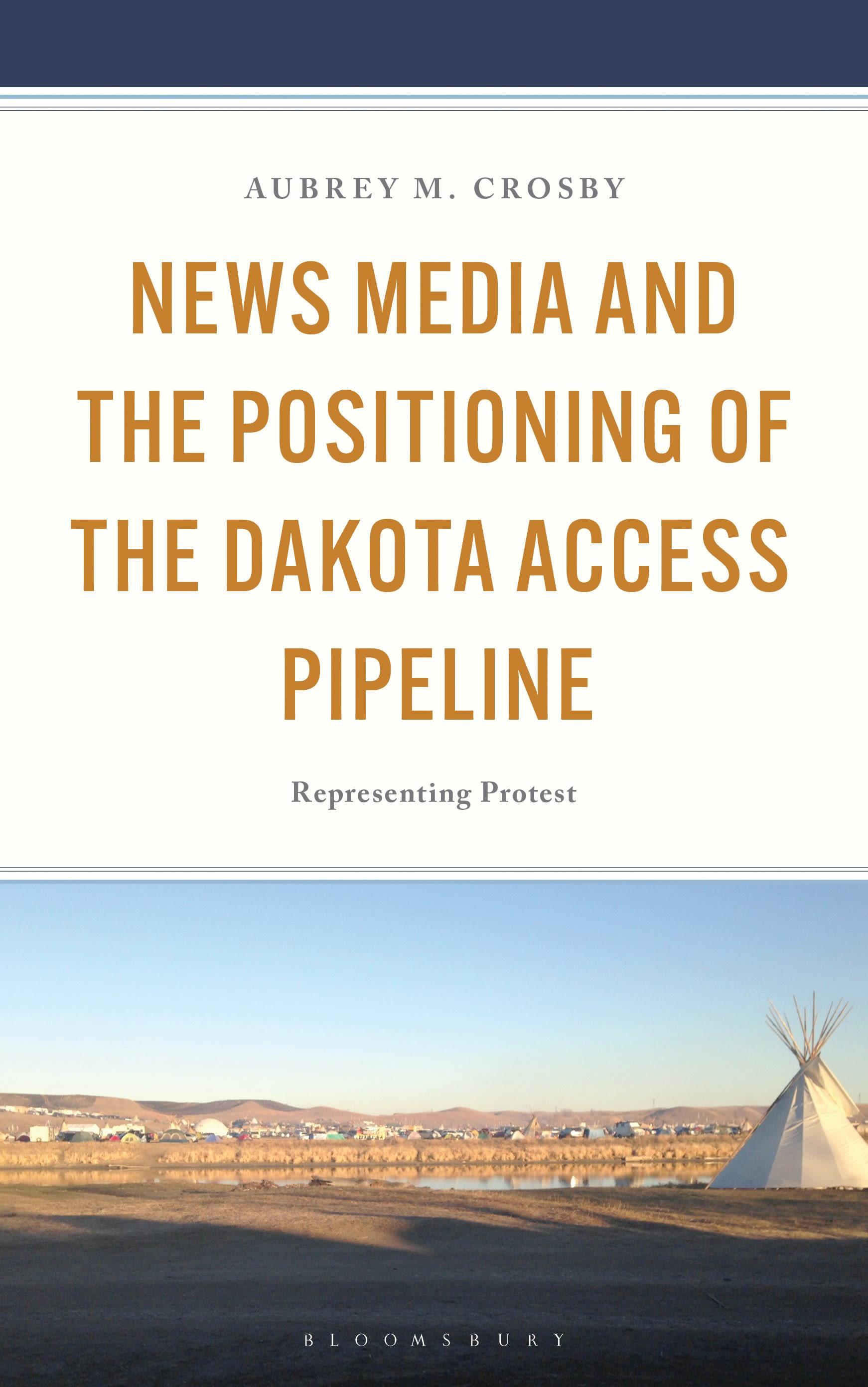
In News Media and the Positioning of the Dakota Access Pipeline: Representing Protest, Aubrey M. Crosby examines the structural and institutional forces governing the socialized practices of news production to provide a constructive critique of how news media frame events and participants in their protest coverage.
Crosby utilizes original data and the frameworks of critical discourse analysis, systemic functional linguistics, and the protest paradigm to perform critical analysis of mainstream news reporting of the Dakota Access Pipeline (DAPL) protests in 2016. She argues that news media significantly reduced the scope of the movement and (re)framed the reality of the #NoDAPL protests by fixating only on select key events and by painting participants as a collective monolith of “protestors,” a functional term which highlights their civil disobedience and erases their individual identities.
Though journalists may have had the opportunity and means to engage more critically with existing discourses, especially those surrounding Indigenous and Tribal sovereignty, mainstream reporting made little effort, if any, to do so. Through rigorous analysis, Crosby demonstrates how “protestors” were aligned with negative actions associated with emotional and destructive intent and juxtaposed with law enforcement, whose aggressive and ethically ambiguous actions were reframed as attempts to maintain law and order. Ultimately, by identifying and drawing attention to both problematic and productive practices of coverage, this work promotes constructive change regarding how power is wielded, maintained, and produced in organizations and in the social realm.
Crosby utilizes original data and the frameworks of critical discourse analysis, systemic functional linguistics, and the protest paradigm to perform critical analysis of mainstream news reporting of the Dakota Access Pipeline (DAPL) protests in 2016. She argues that news media significantly reduced the scope of the movement and (re)framed the reality of the #NoDAPL protests by fixating only on select key events and by painting participants as a collective monolith of “protestors,” a functional term which highlights their civil disobedience and erases their individual identities.
Though journalists may have had the opportunity and means to engage more critically with existing discourses, especially those surrounding Indigenous and Tribal sovereignty, mainstream reporting made little effort, if any, to do so. Through rigorous analysis, Crosby demonstrates how “protestors” were aligned with negative actions associated with emotional and destructive intent and juxtaposed with law enforcement, whose aggressive and ethically ambiguous actions were reframed as attempts to maintain law and order. Ultimately, by identifying and drawing attention to both problematic and productive practices of coverage, this work promotes constructive change regarding how power is wielded, maintained, and produced in organizations and in the social realm.
Sider: 120
Kategori: Film- & Medievetenskap
e-ISBN: 9781978765054
Fraktvekt: 1.2 kg
Sendes innen: 1-2 dager
Betal enkelt med kort, Klarna, Apple Pay eller Google Pay. Ikke fornøyd? Du har alltid 14 dagers angrerett. Les mer i våre vilkår. Har du spørsmål, send oss en e-post på hello@memmo.org.
Memmo gjør det enklere å studere – uansett hvor du er i verden. Hos oss samler du pensumbøker og smarte studieverktøy på ett og samme sted: sammendrag, quizer, podkaster og flashcards. Og så Ted, din studiekompis som svarer på alt du lurer på. Over 50 000 studenter studerer allerede her – bygget for at du skal lære raskere og stresse mindre.