
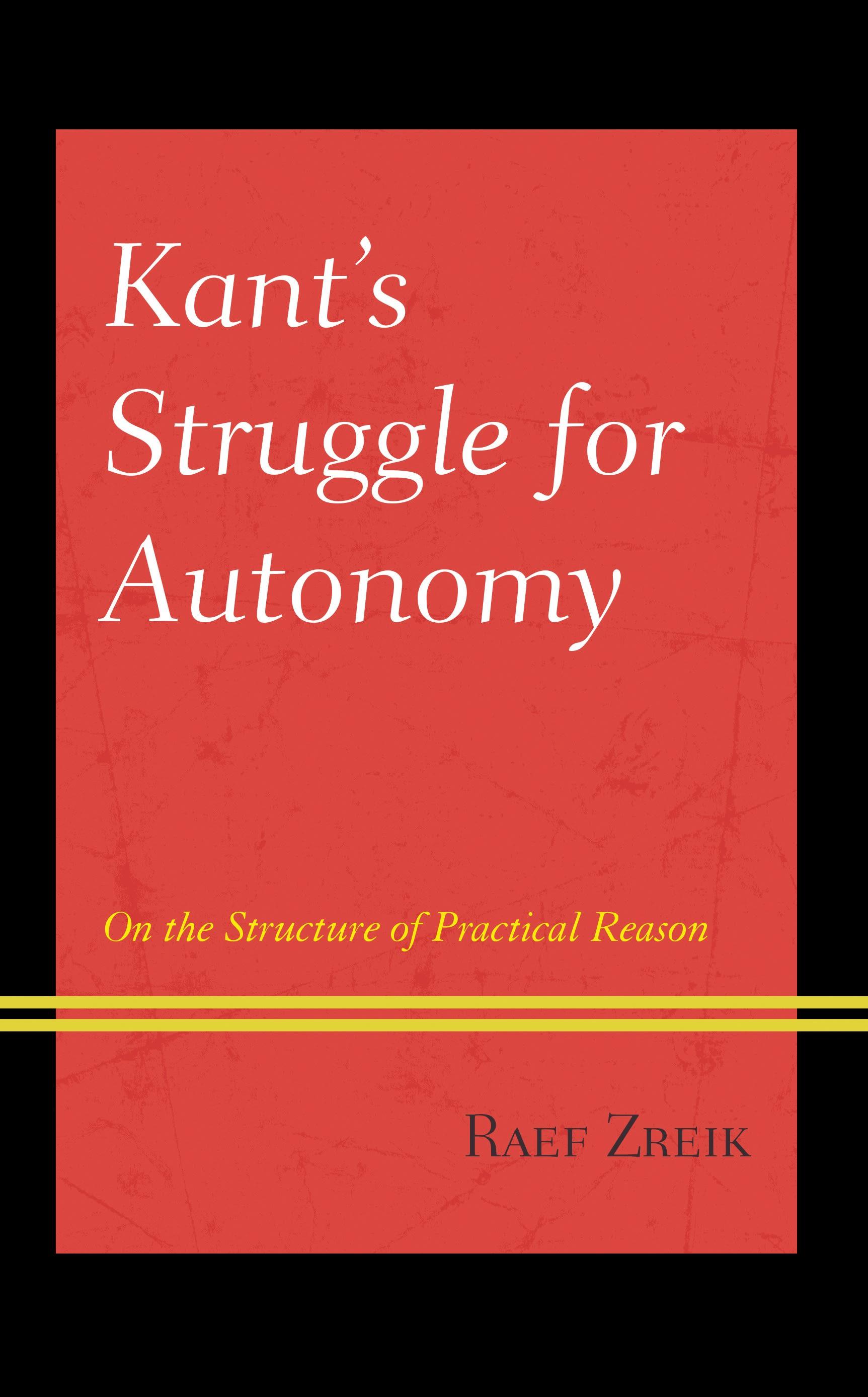
In Kant’s Struggle for Autonomy: On the Structure of Practical Reason, Raef Zreik presents an original synoptic view of Kant’s practical philosophy, uncovering the relatively hidden architectonics of Kant’s system and critically engaging with its broad implications. He begins by investigating the implicit strategy that guides Kant in making the distinctions that establish the autonomous spheres: happiness, morality, justice, public order-legitimacy. The organizing principle of autonomy sets these spheres apart, assuming there is self-sufficiency for each sphere. Zreik then develops a critique of this strategy, showing its limits, its costs, and its inherent instability. He questions self-sufficiency and argues that autonomy is a matter of ongoing struggle between the forces of separation and unification. Zreik proceeds to suggest that we “read Kant backward,” reading early Kant in light of late Kant. This reading reveals Kant's strategy of both taking things apart and putting them together, focusing on the joints, transitions, and metastructures of the system. The image emanating from this account of Kant’s legal and moral philosophy is of an intimate yet tragic conflict within Kant’s thought—one that leaves us to our own judgment as to where to draw the boundaries between spheres, opening the door for politicizing Kant's practical philosophy.
Betal enkelt med kort, Klarna, Apple Pay eller Google Pay. Ikke fornøyd? Du har alltid 14 dagers angrerett. Les mer i våre vilkår. Har du spørsmål, send oss en e-post på hello@memmo.org.
Memmo gjør det enklere å studere – uansett hvor du er i verden. Hos oss samler du pensumbøker og smarte studieverktøy på ett og samme sted: sammendrag, quizer, podkaster og flashcards. Og så Ted, din studiekompis som svarer på alt du lurer på. Over 50 000 studenter studerer allerede her – bygget for at du skal lære raskere og stresse mindre.