
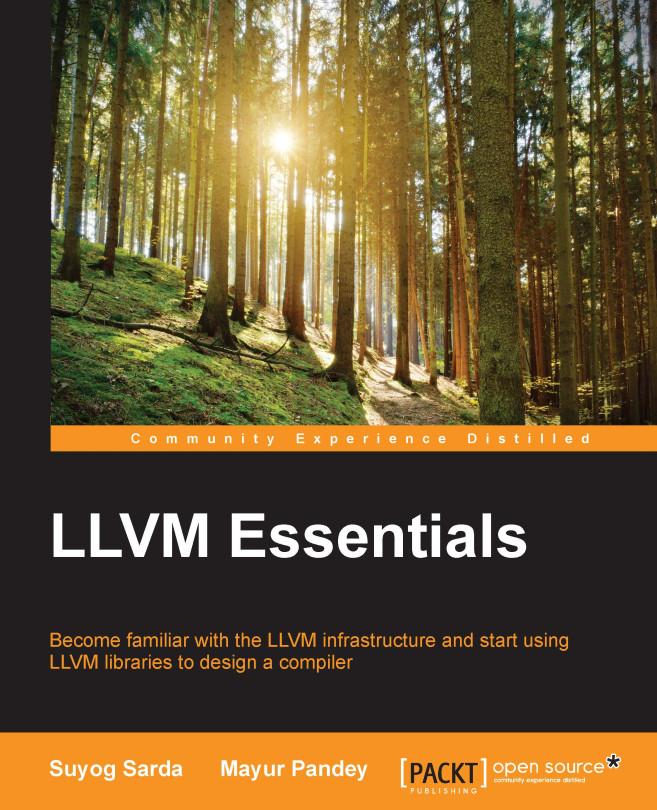
LLVM is currently the point of interest for many firms, and has a very active open source community. It provides us with a compiler infrastructure that can be used to write a compiler for a language. It provides us with a set of reusable libraries that can be used to optimize code, and a target-independent code generator to generate code for different backends. It also provides us with a lot of other utility tools that can be easily integrated into compiler projects.
This book details how you can use the LLVM compiler infrastructure libraries effectively, and will enable you to design your own custom compiler with LLVM in a snap.
We start with the basics, where you’ll get to know all about LLVM. We then cover how you can use LLVM library calls to emit intermediate representation (IR) of simple and complex high-level language paradigms. Moving on, we show you how to implement optimizations at different levels, write an optimization pass, generate code that is independent of a target, and then map the code generated to a backend. The book also walks you through CLANG, IR to IR transformations, advanced IR block transformations, and target machines.
By the end of this book, you’ll be able to easily utilize the LLVM libraries in your own projects.
Betal enkelt med kort, Klarna, Apple Pay eller Google Pay. Ikke fornøyd? Du har alltid 14 dagers angrerett. Les mer i våre vilkår. Har du spørsmål, send oss en e-post på hello@memmo.org.
Memmo gjør det enklere å studere – uansett hvor du er i verden. Hos oss samler du pensumbøker og smarte studieverktøy på ett og samme sted: sammendrag, quizer, podkaster og flashcards. Og så Ted, din studiekompis som svarer på alt du lurer på. Over 50 000 studenter studerer allerede her – bygget for at du skal lære raskere og stresse mindre.