
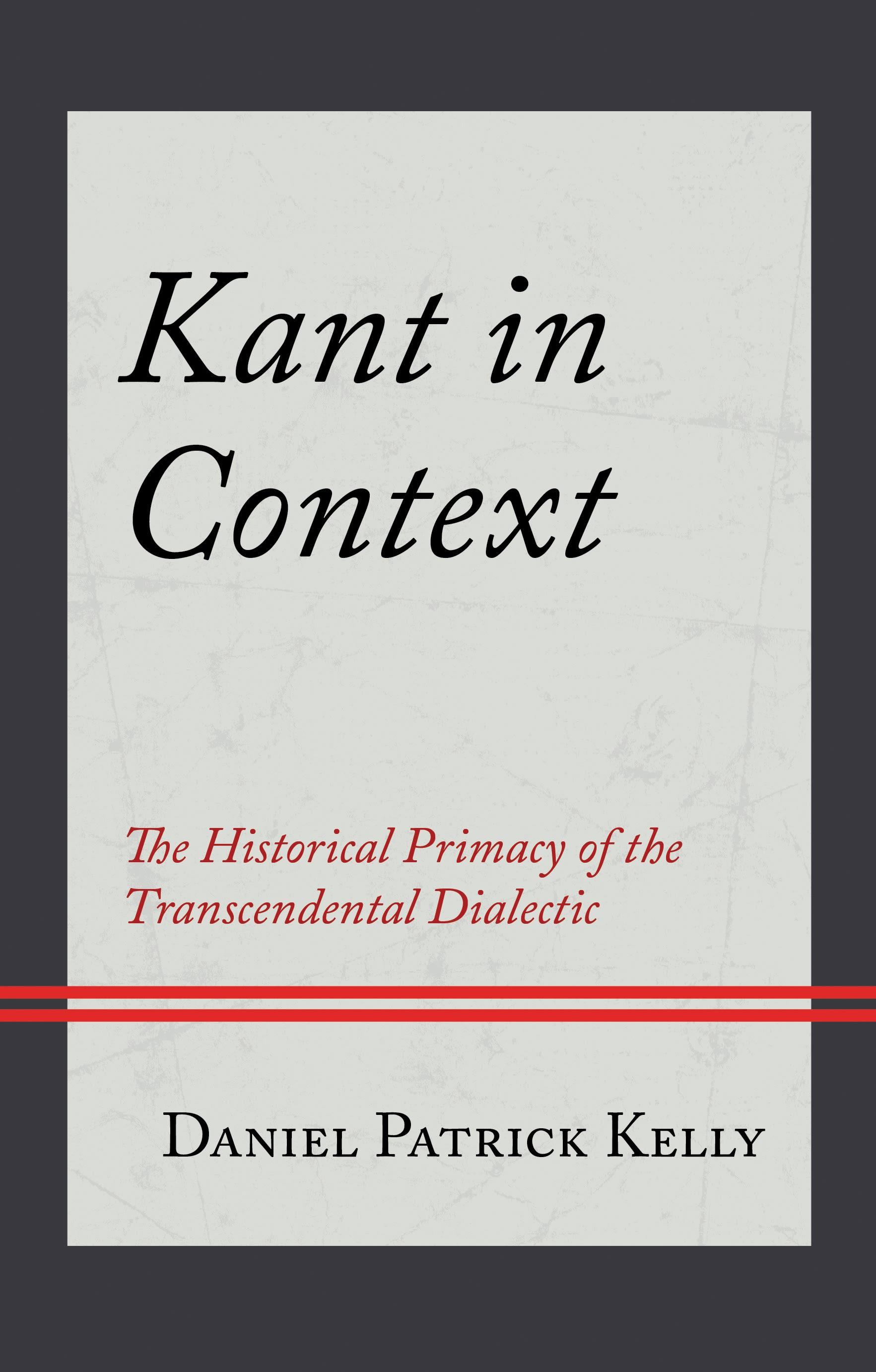
Kant in Context: The Historical Primacy of the Transcendental Dialectic examines the introduction of Kant’s critical philosophy through the lens of historical contextualization. Daniel Patrick Kelly argues that Kant’s seismic Copernican epistemic turn must be adequately positioned and understood within the German philosophical landscape that developed in Spinoza’s wake. This necessary historical analysis illuminates the development and comparative strength of Kant’s emergent transcendental idealism. However, in order to render the introduction of Kant’s critical system sufficient to this historical task, this book heuristically organizes the contents of the Critique of Pure Reason to highlight the work’s meta-philosophical historical conclusions. In this revised take on Kant’s Critique, Kelly argues that the "Transcendental Aesthetic" and subsequent "Transcendental Dialectic" emerge as foundational in understanding Kant’s Critique as a profound historical-methodological development, as they justify and ground the call for his new and supporting science of cognition, placing the "Transcendental Analytic" as inherently secondary in this heuristic reading of the Critique. The author’s overarching contention is that Kant’s identification of the dialectical limitations of metaphysical reasoning provides a more solid justification for Kant’s transcendental idealism than that of the novel postulates of the "Analytic."
Betal enkelt med kort, Klarna, Apple Pay eller Google Pay. Ikke fornøyd? Du har alltid 14 dagers angrerett. Les mer i våre vilkår. Har du spørsmål, send oss en e-post på hello@memmo.org.
Memmo gjør det enklere å studere – uansett hvor du er i verden. Hos oss samler du pensumbøker og smarte studieverktøy på ett og samme sted: sammendrag, quizer, podkaster og flashcards. Og så Ted, din studiekompis som svarer på alt du lurer på. Over 50 000 studenter studerer allerede her – bygget for at du skal lære raskere og stresse mindre.