
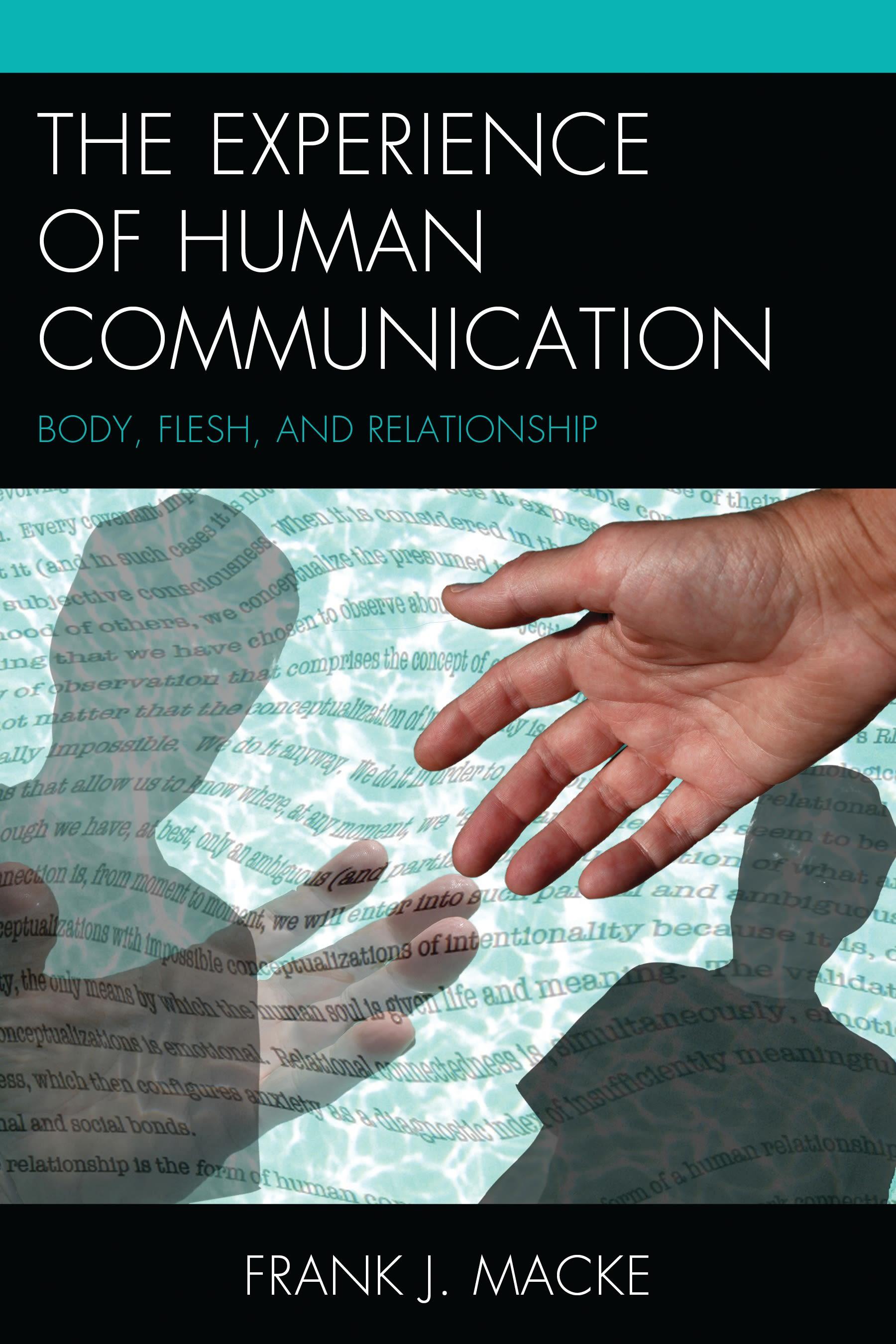
This book deals with matters of embodiment and meaning—in other words, the essential components of what Continental thought, since Heidegger, has come to consider as “communication.” A critical theme of this book concerns the basic tenet that consciousness of one’s Self and one’s body is only possible through human relationship. This is, of course, the phenomenological concept of intersubjectivity. But rather than let this concept remain an abstraction by discussing it as merely a function of language and signs, this work attempts to explicate it empirically. That is, it discusses the manner in which—from infancy to childhood and adolescence (and the dawning of our sexual identities) through physical maturity and old age—we come to experience the ecstasy of what Merleau-Ponty has so poetically termed “flesh.”
It is rarely clear what someone means when she or he uses the word “communication.” An important objective of this book is, thus, to advance understanding of what communication is. In academic discourse, “communication” has come to be understood in a number of contexts—some conflicting and overlapping—as a process, a strategy, an event, an ethic, a mode or instance of information, or even a technology. In virtually all of these discussions, the concept of communication is discussed as though the term’s meaning is well known to the reader. When communication is described as a process, the meaning of the term is held at an operational level—that is, in the exchange of information between one person and another, what must unambiguously be inferred is that “communication” is taking place. In this context, information exchange and communication become functionally synonymous. But as a matter of embodied human psychological experience, there is a world of difference between them. As such, this book attempts to fully consider the question of how we experience the event of human communication. The author offers a pioneering study that advances the raison d’être of the emergent field of “communicology,” while at the same time offering scholars of the human sciences a new way of thinking about embodiment and relational experience.
It is rarely clear what someone means when she or he uses the word “communication.” An important objective of this book is, thus, to advance understanding of what communication is. In academic discourse, “communication” has come to be understood in a number of contexts—some conflicting and overlapping—as a process, a strategy, an event, an ethic, a mode or instance of information, or even a technology. In virtually all of these discussions, the concept of communication is discussed as though the term’s meaning is well known to the reader. When communication is described as a process, the meaning of the term is held at an operational level—that is, in the exchange of information between one person and another, what must unambiguously be inferred is that “communication” is taking place. In this context, information exchange and communication become functionally synonymous. But as a matter of embodied human psychological experience, there is a world of difference between them. As such, this book attempts to fully consider the question of how we experience the event of human communication. The author offers a pioneering study that advances the raison d’être of the emergent field of “communicology,” while at the same time offering scholars of the human sciences a new way of thinking about embodiment and relational experience.
Betal enkelt med kort, Klarna, Apple Pay eller Google Pay. Ikke fornøyd? Du har alltid 14 dagers angrerett. Les mer i våre vilkår. Har du spørsmål, send oss en e-post på hello@memmo.org.
Memmo gjør det enklere å studere – uansett hvor du er i verden. Hos oss samler du pensumbøker og smarte studieverktøy på ett og samme sted: sammendrag, quizer, podkaster og flashcards. Og så Ted, din studiekompis som svarer på alt du lurer på. Over 50 000 studenter studerer allerede her – bygget for at du skal lære raskere og stresse mindre.