
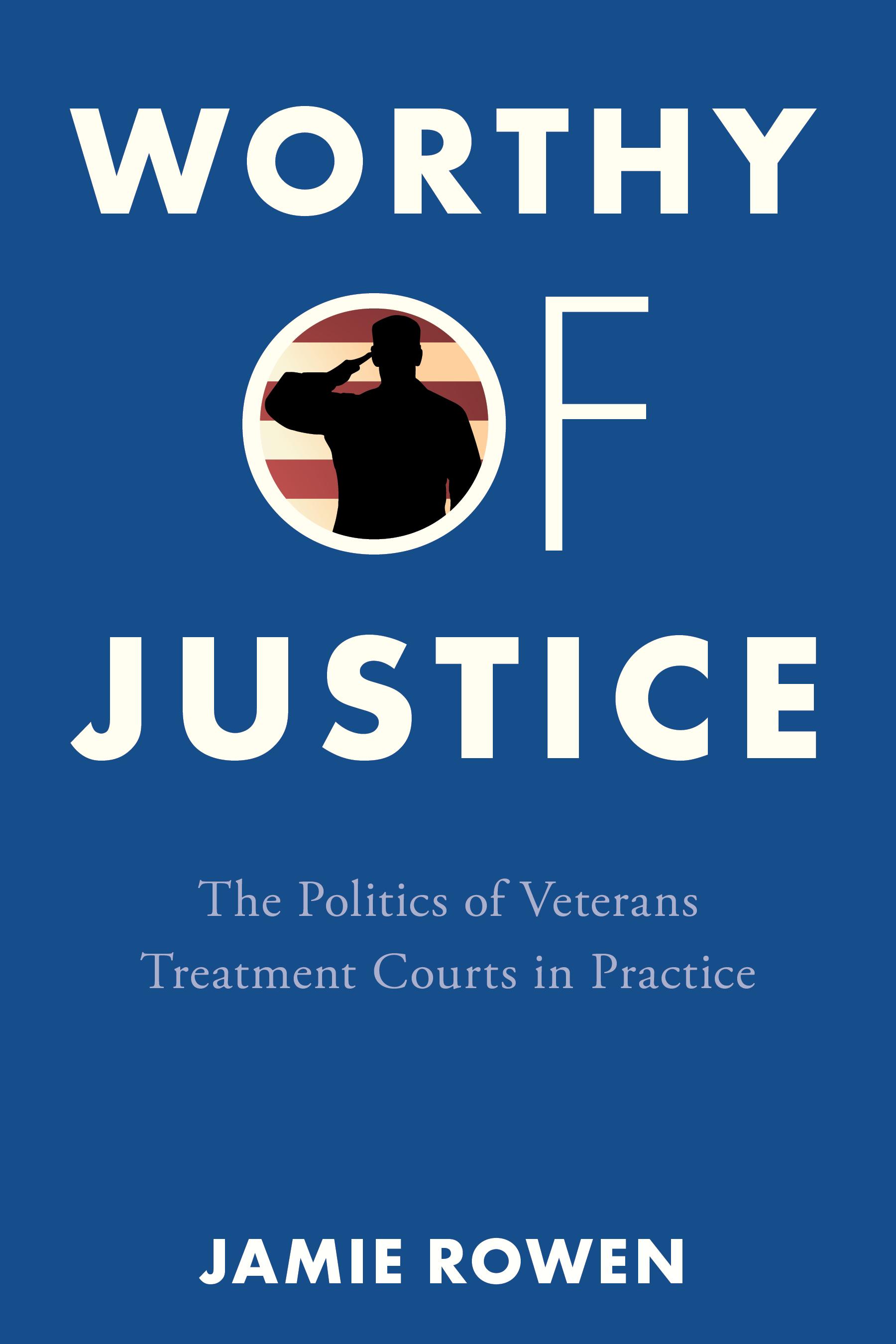
Over the past three decades, jurisdictions across the United States have developed alternatives to traditional criminal procedures and punishments for adults accused of crimes that are associated with substance use and mental health disorders. The Veterans Treatment Court (VTC) is one example of these problem-solving courts. VTCs benefit from the availability of extensive (and free) medical and social services through the Department of Veterans Affairs, as well as the social and political legitimacy that comes with serving veterans.
Worthy of Justice takes this specific form of problem-solving court as lens for examining broader social inequalities in the criminal legal system. Jamie Rowen argues that the rationale for VTCs flows not from what veterans have done but from who they are. Their operations are fueled by the notion that their participants' criminal behavior is the result of military service rather than other personal choices made, thus making them uniquely worthy of public support. In this way, VTCs powerfully expose the contradictions inherent in the idea that criminals deserve punishment.
Rowen draws on fieldwork at three such courts across the US. Ultimately, she illustrates how the politics of crime and the politics of welfare increasingly intersect and, together, construct classes of Americans who are either worthy, or not.
Betal enkelt med kort, Klarna, Apple Pay eller Google Pay. Ikke fornøyd? Du har alltid 14 dagers angrerett. Les mer i våre vilkår. Har du spørsmål, send oss en e-post på hello@memmo.org.
Memmo gjør det enklere å studere – uansett hvor du er i verden. Hos oss samler du pensumbøker og smarte studieverktøy på ett og samme sted: sammendrag, quizer, podkaster og flashcards. Og så Ted, din studiekompis som svarer på alt du lurer på. Over 50 000 studenter studerer allerede her – bygget for at du skal lære raskere og stresse mindre.