
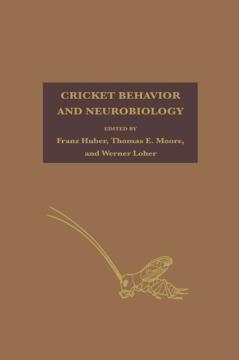
The world of crickets has long been a world of scientific adventure and human fascination. Because of their remarkable ways of communicating and because their nervous and endocrine systems are easily accessible to researchers, crickets can be studied and analyzed with great effectiveness. Starting in the 1960s, vastly improved behavioral and neurobiological techniques have brought them to the frontier of the new field of neuroethology.
Here, in the most comprehensive book on crickets ever compiled, twenty-five leading scientists detail the present state of cricket research both at conceptual and at experimental levels. They tell about the manifold strategies crickets use in matching development with seasons and habitats, finding mates, and avoiding parasites and predators, and they describe the physiological mechanisms, especially the neuronal mechanisms, underlying cricket behavior. Their book is at once about communication, comparative physiology and anatomy, and environmental interaction.
More than half of Cricket Behavior and Neurobiology is devoted to acoustic behavior and bioacoustics. It is intended for those interested in entomology, general and comparative physiology, biophysics, endocrinology, and chronobiology. It offers new information for behavioral physiologists and ecologists, bioacousticians, and especially neurobiologists concerned with behavior.
Betal enkelt med kort, Klarna, Apple Pay eller Google Pay. Ikke fornøyd? Du har alltid 14 dagers angrerett. Les mer i våre vilkår. Har du spørsmål, send oss en e-post på hello@memmo.org.
Memmo gjør det enklere å studere – uansett hvor du er i verden. Hos oss samler du pensumbøker og smarte studieverktøy på ett og samme sted: sammendrag, quizer, podkaster og flashcards. Og så Ted, din studiekompis som svarer på alt du lurer på. Over 50 000 studenter studerer allerede her – bygget for at du skal lære raskere og stresse mindre.