
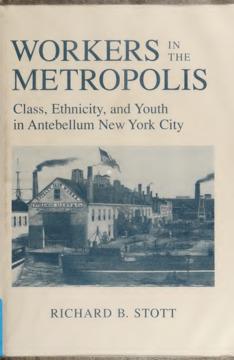
The working class in New York City was remade in the mid-nineteenth century. In the 1820s a substantial majority of city artisans were native-born; by the 1850s three-quarters of the city's laboring men and women were immigrants. How did the influx of this large group of young adults affect the city's working class? What determined the texture of working-class life during the antebellum period? Richard Stott addresses these questions as he explores the social and economic dimensions of working-class culture.
Working-class culture, Stott maintains, is grounded in the material environment, and when work, population, consumption, and the uses of urban space change as rapidly as they did in the mid-nineteenth century, culture will be transformed. Using workers' first-person accounts—letters, diaries, and reminiscences—as evidence, and focusing on such diverse topics as neighborhoods, diet, saloons, and dialect, he traces the rise of a new, youth-oriented working-class culture. By illuminating the everyday experiences of city workers, he shows that the culture emerging in the 1850s was a culture clearly different from that of native-born artisans of an earlier period and from that of the middle class as well.
Betal enkelt med kort, Klarna, Apple Pay eller Google Pay. Ikke fornøyd? Du har alltid 14 dagers angrerett. Les mer i våre vilkår. Har du spørsmål, send oss en e-post på hello@memmo.org.
Memmo gjør det enklere å studere – uansett hvor du er i verden. Hos oss samler du pensumbøker og smarte studieverktøy på ett og samme sted: sammendrag, quizer, podkaster og flashcards. Og så Ted, din studiekompis som svarer på alt du lurer på. Over 50 000 studenter studerer allerede her – bygget for at du skal lære raskere og stresse mindre.