
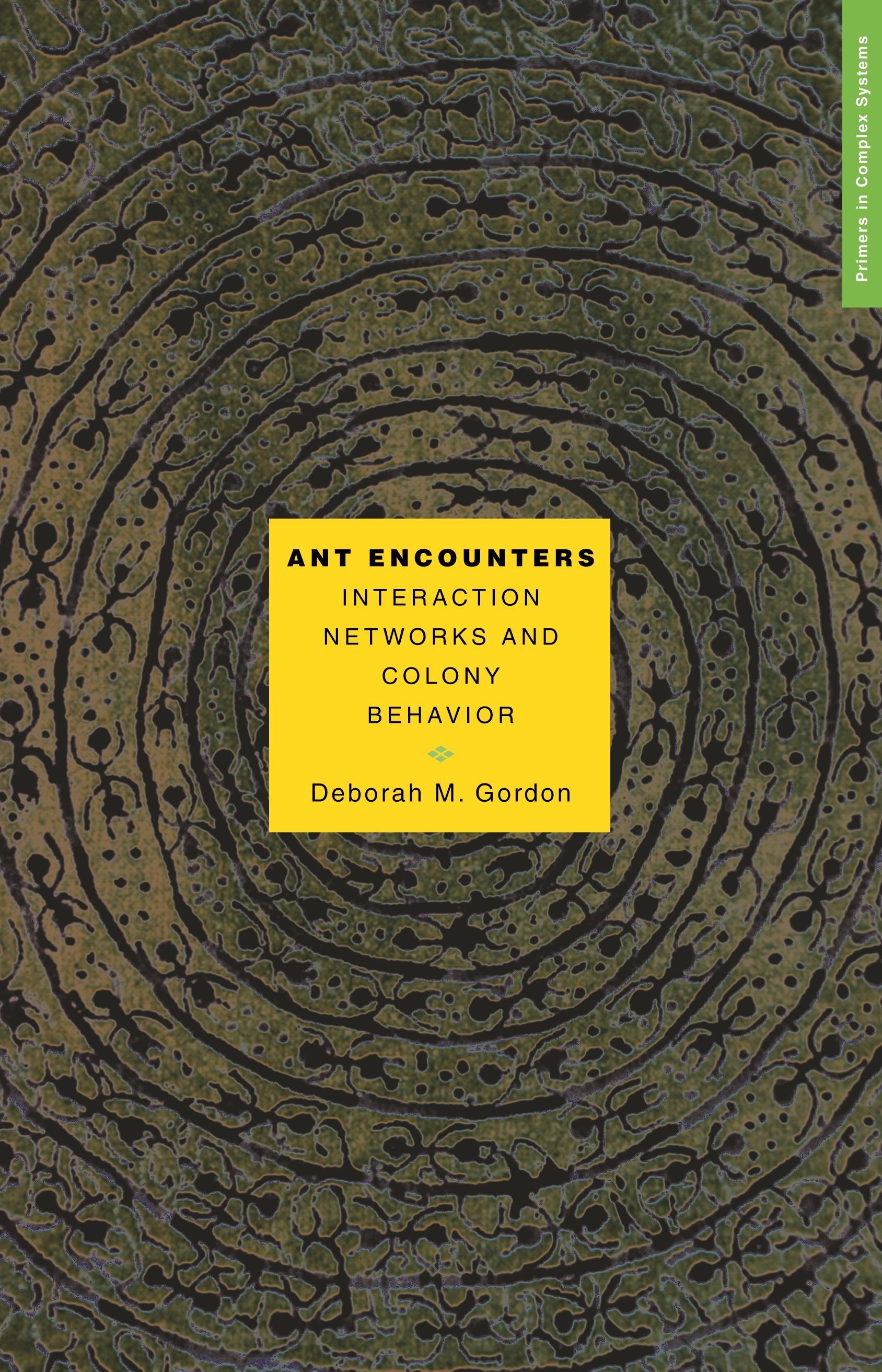
How do ant colonies get anything done, when no one is in charge? An ant colony operates without a central control or hierarchy, and no ant directs another. Instead, ants decide what to do based on the rate, rhythm, and pattern of individual encounters and interactions--resulting in a dynamic network that coordinates the functions of the colony. Ant Encounters provides a revealing and accessible look into ant behavior from this complex systems perspective.
Focusing on the moment-to-moment behavior of ant colonies, Deborah Gordon investigates the role of interaction networks in regulating colony behavior and relations among ant colonies. She shows how ant behavior within and between colonies arises from local interactions of individuals, and how interaction networks develop as a colony grows older and larger. The more rapidly ants react to their encounters, the more sensitively the entire colony responds to changing conditions. Gordon explores whether such reactive networks help a colony to survive and reproduce, how natural selection shapes colony networks, and how these structures compare to other analogous complex systems.
Ant Encounters sheds light on the organizational behavior, ecology, and evolution of these diverse and ubiquitous social insects.
Betal enkelt med kort, Klarna, Apple Pay eller Google Pay. Ikke fornøyd? Du har alltid 14 dagers angrerett. Les mer i våre vilkår. Har du spørsmål, send oss en e-post på hello@memmo.org.
Memmo gjør det enklere å studere – uansett hvor du er i verden. Hos oss samler du pensumbøker og smarte studieverktøy på ett og samme sted: sammendrag, quizer, podkaster og flashcards. Og så Ted, din studiekompis som svarer på alt du lurer på. Over 50 000 studenter studerer allerede her – bygget for at du skal lære raskere og stresse mindre.