
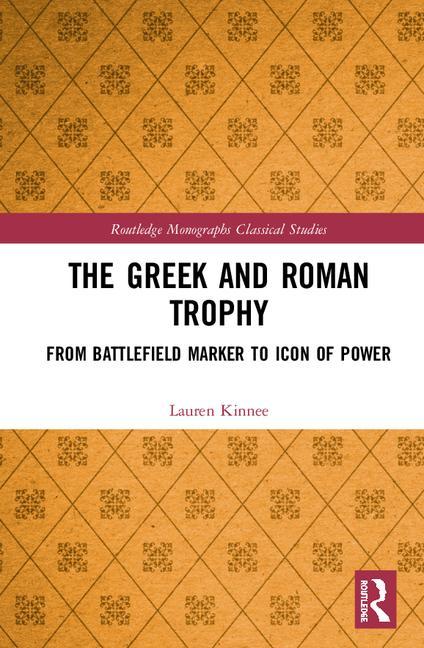
In The Greek and Roman Trophy: From Battlefield Marker to Icon of Power, Kinnee presents the first monographic treatment of ancient trophies in sixty years. The study spans Archaic Greece through the Augustan Principate. Kinnee aims to create a holistic view of this complex monument-type by breaking down boundaries between the study of art history, philology, the history of warfare, and the anthropology of religion and magic. Ultimately, the kaleidoscopic picture that emerges is of an ad hoc anthropomorphic Greek talisman that gradually developed into a sophisticated, Augustan sculptural or architectural statement of power. The former, a product of the hoplite phalanx, disappeared from battlefields as the Macedonian cavalry grew in importance, shifting instead onto coins and into rhetoric, where it became a statement of military might. For their part, the Romans seem to have encountered the trophy as an icon on Syracusan coinage. Recognizing its value as a statement of territorial ownership, the Romans spent two centuries honing the trophy-concept into an empire-building tool, planted at key locations around the Mediterranean to assert Roman presence and dominance.
This volume covers a ubiquitous but poorly understood phenomenon and will therefore be instructive to upper-level undergraduates, graduate students, and scholars in all fields of Classical Studies.
Betal enkelt med kort, Klarna, Apple Pay eller Google Pay. Ikke fornøyd? Du har alltid 14 dagers angrerett. Les mer i våre vilkår. Har du spørsmål, send oss en e-post på hello@memmo.org.
Memmo gjør det enklere å studere – uansett hvor du er i verden. Hos oss samler du pensumbøker og smarte studieverktøy på ett og samme sted: sammendrag, quizer, podkaster og flashcards. Og så Ted, din studiekompis som svarer på alt du lurer på. Over 50 000 studenter studerer allerede her – bygget for at du skal lære raskere og stresse mindre.