
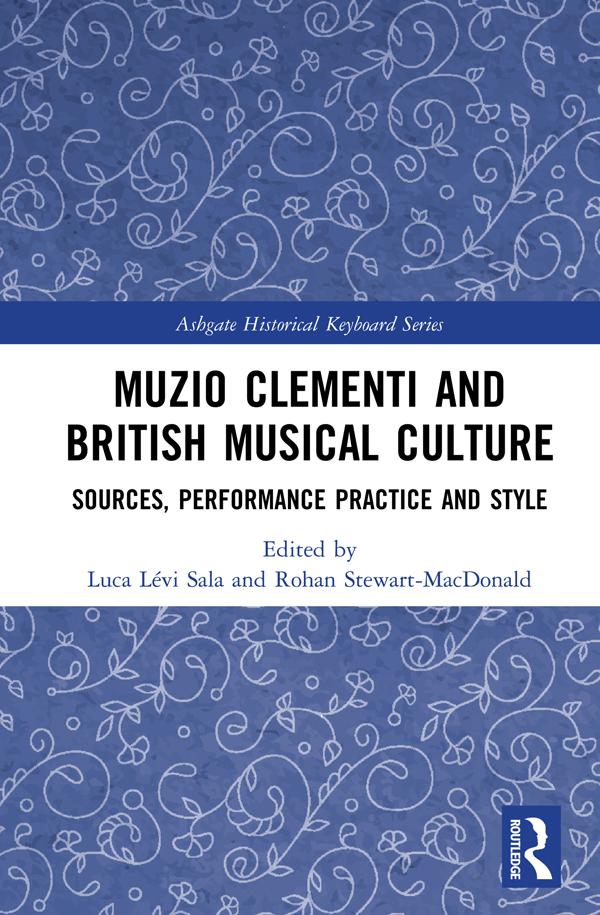
Recent scholarship has vanquished the traditional perception of nineteenth-century Britain as a musical wasteland. In addition to attempting more balanced assessments of the achievements of British composers of this period, scholars have begun to explore the web of reciprocal relationships between the societal, economic and cultural dynamics arising from the industrial revolution, the Napoleonic wars, and the ever-changing contours of British music publishing, music consumption, concert life, instrument design, performance practice, pedagogy and composition. Muzio Clementi (1752–1832) provides an ideal case-study for continued exploration of this web of relationships. Based in London for much of his life, whilst still maintaining contact with continental developments, Clementi achieved notable success in a diversity of activities that centred mainly on the piano. The present book explores Clementi’s multivalent contribution to piano performance, pedagogy, composition and manufacture in relation to British musical life and its international dimensions. An overriding purpose is to interrogate when, how and to what extent a distinctive British musical culture emerged in the early nineteenth century. Much recent work on Clementi has centred on the Italian National Edition of his complete works (MiBACT); several chapters report on this project, whilst continuing to pursue the book’s broader themes.
Betal enkelt med kort, Klarna, Apple Pay eller Google Pay. Ikke fornøyd? Du har alltid 14 dagers angrerett. Les mer i våre vilkår. Har du spørsmål, send oss en e-post på hello@memmo.org.
Memmo gjør det enklere å studere – uansett hvor du er i verden. Hos oss samler du pensumbøker og smarte studieverktøy på ett og samme sted: sammendrag, quizer, podkaster og flashcards. Og så Ted, din studiekompis som svarer på alt du lurer på. Over 50 000 studenter studerer allerede her – bygget for at du skal lære raskere og stresse mindre.