
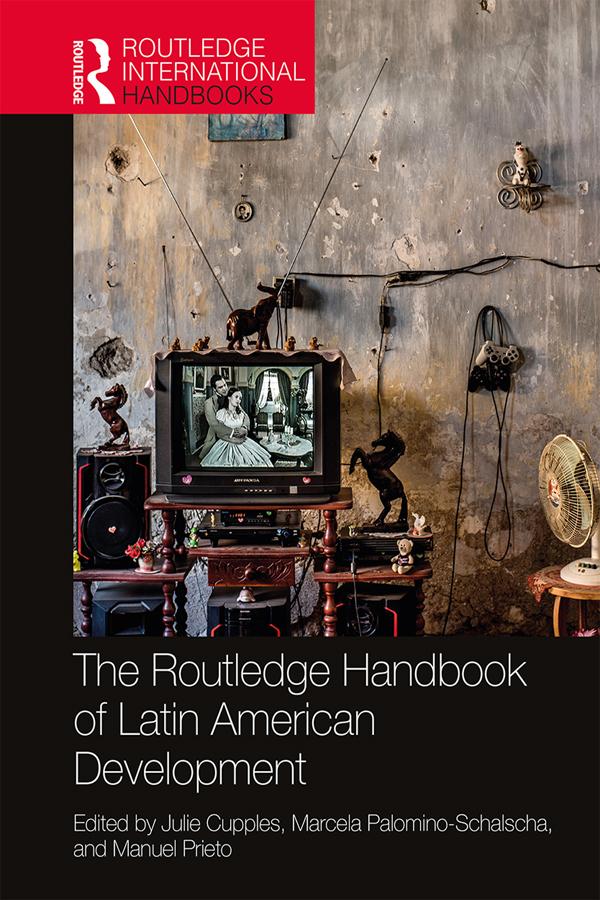
The Routledge Handbook of Latin American Development seeks to engage with comprehensive, contemporary, and critical theoretical debates on Latin American development. The volume draws on contributions from across the humanities and social sciences and, unlike earlier volumes of this kind, explicitly highlights the disruptions to the field being brought by a range of anti-capitalist, decolonial, feminist, and ontological intellectual contributions.
The chapters consider in depth the harms and suffering caused by various oppressive forces, as well as the creative and often revolutionary ways in which ordinary Latin Americans resist, fight back, and work to construct development defined broadly as the struggle for a better and more dignified life. The book covers many key themes including development policy and practice; neoliberalism and its aftermath; the role played by social movements in cities and rural areas; the politics of water, oil, and other environmental resources; indigenous and Afro-descendant rights; and the struggles for gender equality.
With contributions from authors working in Latin America, the US and Canada, Europe, and New Zealand at a range of universities and other organizations, the handbook is an invaluable resource for students and teachers in development studies, Latin American studies, cultural studies, human geography, anthropology, sociology, political science, and economics, as well as for activists and development practitioners.
Betal enkelt med kort, Klarna, Apple Pay eller Google Pay. Ikke fornøyd? Du har alltid 14 dagers angrerett. Les mer i våre vilkår. Har du spørsmål, send oss en e-post på hello@memmo.org.
Memmo gjør det enklere å studere – uansett hvor du er i verden. Hos oss samler du pensumbøker og smarte studieverktøy på ett og samme sted: sammendrag, quizer, podkaster og flashcards. Og så Ted, din studiekompis som svarer på alt du lurer på. Over 50 000 studenter studerer allerede her – bygget for at du skal lære raskere og stresse mindre.