
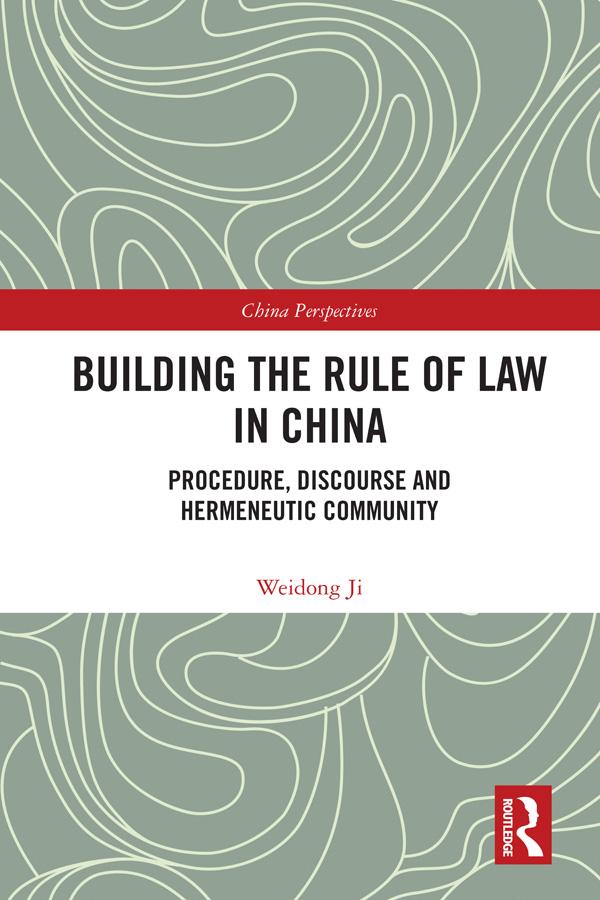
After thirty years of Mao era (1949-1979) which was struggle-based, the Communist Party of China has begun to change its position as a pioneering revolutionary party, evolving into a universal ruling party that transcends class interests. Meanwhile, administrative and judicial reforms oriented toward a more efficient, serving government and the rule of law have been actively carried out.
As the earliest work on constructive jurisprudence of new proceduralism in China, this book elucidates some of the most critical problems in the process of constructing a legal order and realizing institutional innovation in China: democracy, fair and reasonable procedure, interpretation techniques, cognitive ability of legislation, position and function of the jurist group, and professional ethics, etc. Besides, it expounds five pairs of contradictions in the modernization process of Chinese legal system, namely, substantial and procedural justice, moral and legal debates, formal and reflective rationality, the major responsibility on bureaucrats and lawyers, and the motivation of public welfare and profit, and explores appropriate approaches to combine the different factors.
Scholars and students in Chinese legal and social transformation studies will be attracted by this book. Furthermore, it will help different civilizations conduct rational dialogues on justice and order.
Betal enkelt med kort, Klarna, Apple Pay eller Google Pay. Ikke fornøyd? Du har alltid 14 dagers angrerett. Les mer i våre vilkår. Har du spørsmål, send oss en e-post på hello@memmo.org.
Memmo gjør det enklere å studere – uansett hvor du er i verden. Hos oss samler du pensumbøker og smarte studieverktøy på ett og samme sted: sammendrag, quizer, podkaster og flashcards. Og så Ted, din studiekompis som svarer på alt du lurer på. Over 50 000 studenter studerer allerede her – bygget for at du skal lære raskere og stresse mindre.