
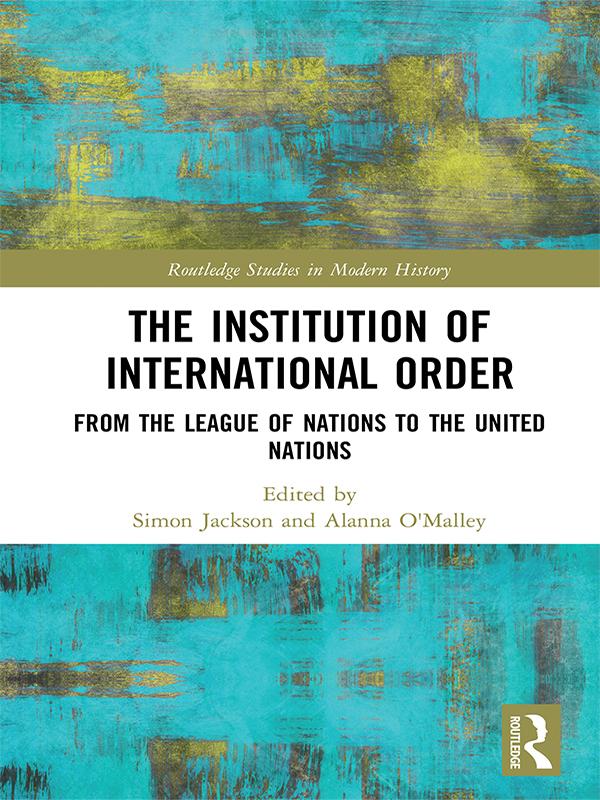
This volume delivers a history of internationalism at the League of Nations and the United Nations (UN), with a focus on the period from the 1920s to the 1970s, when the nation-state ascended to global hegemony as a political formation. Combining global, regional and local scaes of analysis, the essays presented here provide an interpretation of the two institutions — and their complex interrelationship — that is planetary in scale but also pioneeringly multi-local. Our central argument is that although the League and the UN shaped internationalism from the centre, they were themselves moulded just as powerfully by internationalisms that welled up globally, far beyond Geneva and New York City. The contributions are organised into three broad thematic sections, the first focused on the production of norms, the second on the development of expertise and the third on the global re-ordering of empire. By showing how the ruptures and continuities between the two international organisations have shaped the content and format of what we now refer to as ‘global governance’, the collection determinedly sets the Cold War and the emergence of the Third World into a single analytical frame alongside the crisis of empire after World War One and the geopolitics of the Great Depression. Each of these essays reveals how the League of Nations and the United Nations provided a global platform for formalising and proliferating political ideas and how the two institutions generated new spectrums of negotiation and dissidence and re-codified norms. As an ensemble, the book shows how the League of Nations and the United Nations constructed and progressively re-fashioned the basic building blocks of international society right across the twentieth century. Developing the new international history’s view of the League and UN as dynamic, complex forces, the book demonstrates that both organisations should be understood to have played an active role, not just in mediating a world of empires and then one of nation-states, but in forging the many principles and tenets by which international society is structured.
Betal enkelt med kort, Klarna, Apple Pay eller Google Pay. Ikke fornøyd? Du har alltid 14 dagers angrerett. Les mer i våre vilkår. Har du spørsmål, send oss en e-post på hello@memmo.org.
Memmo gjør det enklere å studere – uansett hvor du er i verden. Hos oss samler du pensumbøker og smarte studieverktøy på ett og samme sted: sammendrag, quizer, podkaster og flashcards. Og så Ted, din studiekompis som svarer på alt du lurer på. Over 50 000 studenter studerer allerede her – bygget for at du skal lære raskere og stresse mindre.