
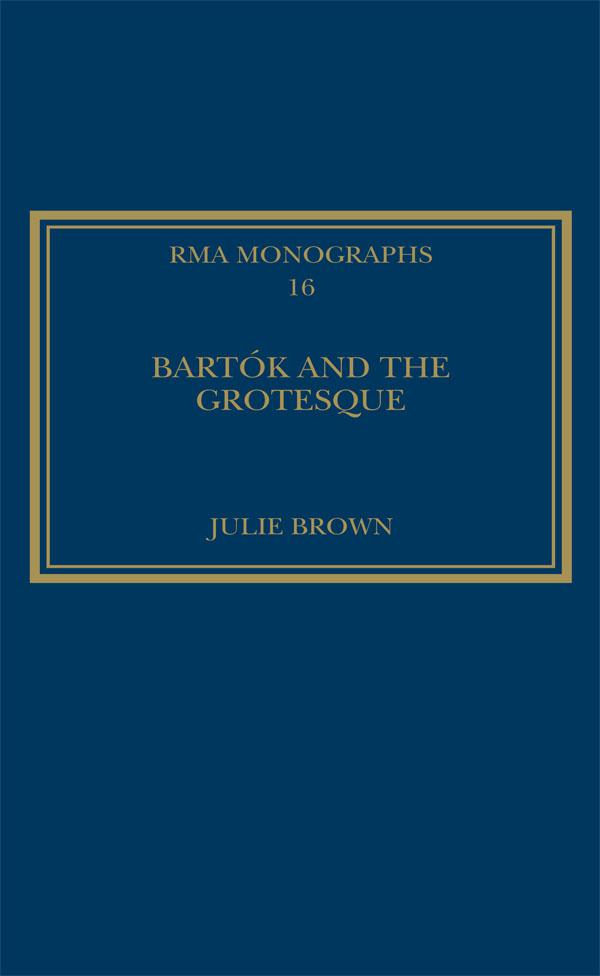
The grotesque is one of art's most puzzling figures - transgressive, comprising an unresolveable hybrid, generally focussing on the human body, full of hyperbole, and ultimately semantically deeply puzzling. In Bluebeard's Castle (1911), The Wooden Prince (1916/17), The Miraculous Mandarin (1919/24, rev. 1931) and Cantata Profana (1930), Bart ngaged scenarios featuring either overtly grotesque bodies or closely related transformations and violations of the body. In a number of instrumental works he also overtly engaged grotesque satirical strategies, sometimes - as in Two Portraits: 'Ideal' and 'Grotesque' - indicating this in the title. In this book, Julie Brown argues that Bart concerns with stylistic hybridity (high-low, East-West, tonal-atonal-modal), the body, and the grotesque are inter-connected. While Bart eveloped each interest in highly individual ways, and did so separately to a considerable extent, the three concerns remained conceptually interlinked. All three were thoroughly implicated in cultural constructions of the Modern during the period in which Bart as composing.
Betal enkelt med kort, Klarna, Apple Pay eller Google Pay. Ikke fornøyd? Du har alltid 14 dagers angrerett. Les mer i våre vilkår. Har du spørsmål, send oss en e-post på hello@memmo.org.
Memmo gjør det enklere å studere – uansett hvor du er i verden. Hos oss samler du pensumbøker og smarte studieverktøy på ett og samme sted: sammendrag, quizer, podkaster og flashcards. Og så Ted, din studiekompis som svarer på alt du lurer på. Over 50 000 studenter studerer allerede her – bygget for at du skal lære raskere og stresse mindre.
Du vil kanskje også like
Kjøp boken0