
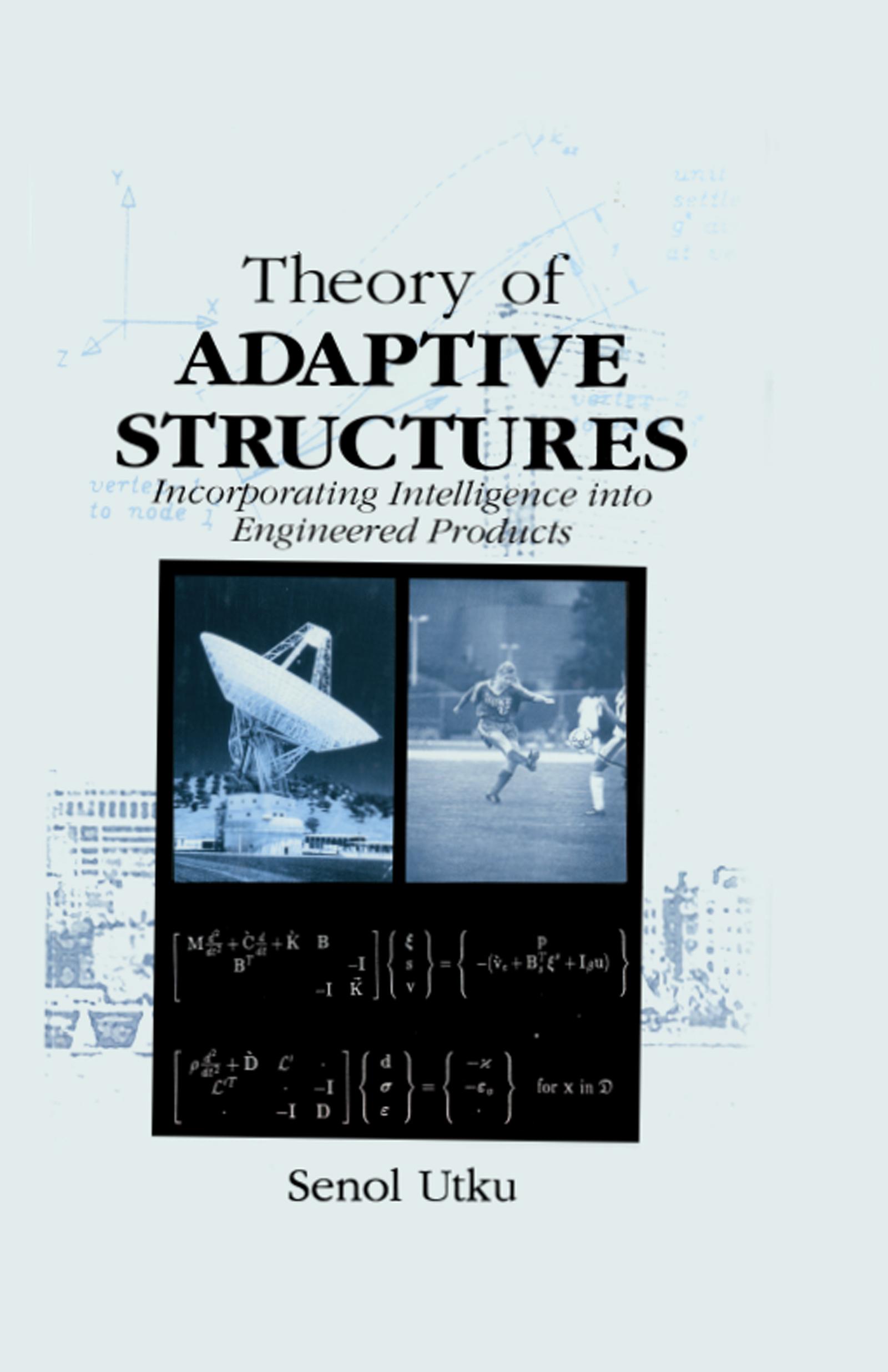
Theory of Adaptive Structures provides the basic theory for controlling adaptive structures in static and dynamic environments. It synthesizes well-established theories on modern control as well as statics and dynamics of deformable bodies. Discussions concentrate on the discrete parameter adaptive structures dealing with actuator placement, actuator selection, and actuation computation problems - keeping these structures at close proximity of any chosen nominal state with the least energy consumption. An introduction to the distributed parameter adaptive structures is also provided.
The book follows that modern trend in research and industry striving to incorporate intelligence into engineered products through microprocessors that are becoming smaller, faster, and cheaper at astounding rates. Not using them in engineered products may become an enormous liability.
Resulting from the advances in materials technology on sensors and actuator technologies as well as the availability of very powerful and reliable microprocessors, there is an ever-increasing interest in actively controlling the behavior of engineering systems. Engineers and engineering scientists must revive and broaden their activities to maximize applications for predicting and controlling the behavior of deformable bodies.
Topics include:
The technology of adaptive structures has created an environment where the analysis, not the computation, of structural response - du
Betal enkelt med kort, Klarna, Apple Pay eller Google Pay. Ikke fornøyd? Du har alltid 14 dagers angrerett. Les mer i våre vilkår. Har du spørsmål, send oss en e-post på hello@memmo.org.
Memmo gjør det enklere å studere – uansett hvor du er i verden. Hos oss samler du pensumbøker og smarte studieverktøy på ett og samme sted: sammendrag, quizer, podkaster og flashcards. Og så Ted, din studiekompis som svarer på alt du lurer på. Over 50 000 studenter studerer allerede her – bygget for at du skal lære raskere og stresse mindre.