
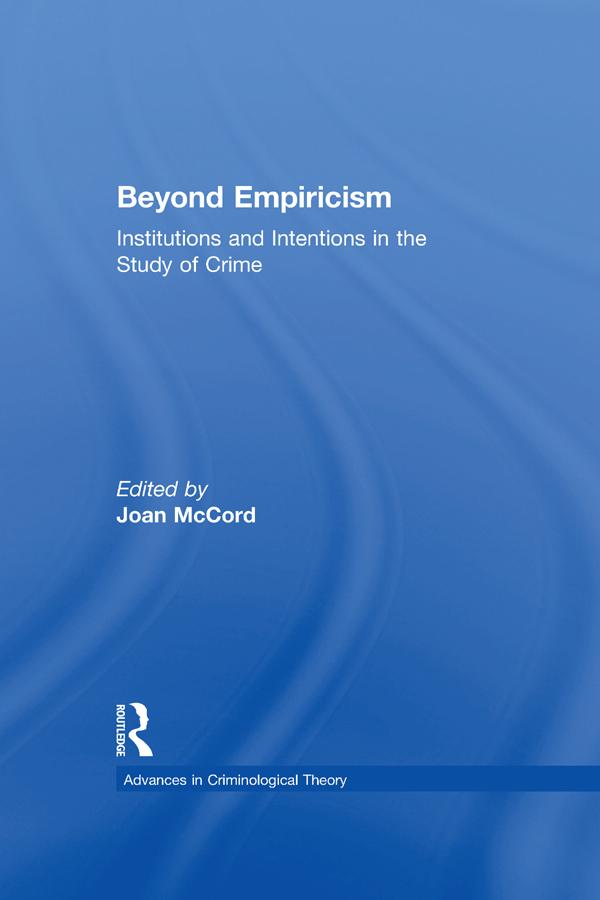
Beyond Empiricism expands the discourse on theories of criminal behavior. It considers institutional, social, and individual issues related to criminal behavior, while individually each raises questions about the adequacy of current theoretical claims. The topics have significant implications both for policy and research in criminology.
Per-Olof Wikstrom introduces a cross-level action theory of crime. He suggests that better understanding of causal mechanisms can lead to a situational theory of action based on perception of alternatives and the process of choice. David Wolcott and Steven Schlossman provide new perspectives on the issues of racial disparity and the incarceration of adolescents in adult prisons. These authors highlight gaps in our understanding of early twentieth-century juvenile justice and negate some popular claims about recent changes in the criminal law. Peter Grabosky spotlights privatization policies in the criminal justice system, suggesting a framework for analyzing the balance of advantage resulting from three basic forms of institutional relationships in policing. Steven Messner and Richard Rosenfeld discuss why institutional analysis has been seriously underdeveloped in etiological analyses of crime. Jordan Pederson and Matthew Shane scrutinize the concept of aggression. Their descriptions of aggressive behavior among non-human animals provide a fascinating backdrop for understanding human actions. Joan McCord emphasizes the intentionality of crimes as she argues that to understand what causes crime, one must have a theory about what it means to act intentionally. After critically appraising prior theories, McCord introduces and defends a new theory of motivation based on a post-empiricist theory of language.
This latest volume in the distinguished Advances in Criminological Theory series continues to add to the theoretical underpinnings of the field, and will be important to all collections of social science research on criminology.
Betal enkelt med kort, Klarna, Apple Pay eller Google Pay. Ikke fornøyd? Du har alltid 14 dagers angrerett. Les mer i våre vilkår. Har du spørsmål, send oss en e-post på hello@memmo.org.
Memmo gjør det enklere å studere – uansett hvor du er i verden. Hos oss samler du pensumbøker og smarte studieverktøy på ett og samme sted: sammendrag, quizer, podkaster og flashcards. Og så Ted, din studiekompis som svarer på alt du lurer på. Over 50 000 studenter studerer allerede her – bygget for at du skal lære raskere og stresse mindre.