
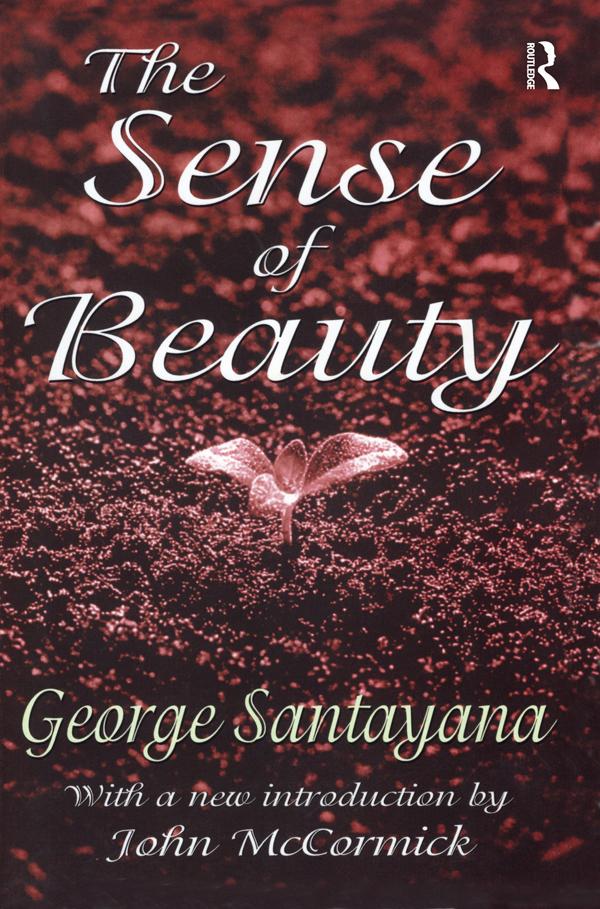
From antiquity to the present, many have written on the subject of beauty, but precious few have done so with the capacity themselves to write beautifully. The Sense of Beauty is that rare exception. This remarkable early work of the great American philosopher, George Santayana, features a quality of prose that is as wondrous as what he had to say. Indeed, his summation remains a flawless classical statement. "Beauty seems to be the clearest manifestation of perfection, and the best evidence of its possibility. If perfection is, as it should be, the ultimate justification of being, we may understand the ground of the moral dignity of beauty. Be'auty is a pledge of the possible conformity between the soul and nature, and consequently a ground of faith in the supremacy of the good."
The editor of this new edition, John McGormick, reminds us that The Sense of Beauty is the first work in aesthetics written in the United States. Santayana was versed in the history of his subject, from Plato and Aristotle to Schopenhauer and Taine in the nineteenth century. Santayana took as his task a complete rethinking of the idea that beauty is embedded in objects. Rather beauty is an emotion, a value, and a sense of the good. In this, aesthetics was unlike ethics: not a correction of evil or pursuit of the virtuous. Rather it is a pleasure that resides in the sense of self. The work is divided into chapters on the materials of beauty, form and expression. A good many of Santayana's later works are presaged by this early effort. And this volume also anticipates the development of art as a movement as well as a value apart from other aspects of life.
The work is written without posturing, without hectoring. Santayana is nonetheless able to give expression to strong views. His preferences are made perfectly plain. Perhaps the key is a powerful belief that beauty is an adornment not a material necessity. But that does mean art is trivial. Quite the contrary, the good life is precisely the extent to which such "adornments" as painting, poetry or music come to define the lives of individuals and civilizations alike. This is, in short, a major work that can still inform and move us a century after its first composition.
Betal enkelt med kort, Klarna, Apple Pay eller Google Pay. Ikke fornøyd? Du har alltid 14 dagers angrerett. Les mer i våre vilkår. Har du spørsmål, send oss en e-post på hello@memmo.org.
Memmo gjør det enklere å studere – uansett hvor du er i verden. Hos oss samler du pensumbøker og smarte studieverktøy på ett og samme sted: sammendrag, quizer, podkaster og flashcards. Og så Ted, din studiekompis som svarer på alt du lurer på. Over 50 000 studenter studerer allerede her – bygget for at du skal lære raskere og stresse mindre.