
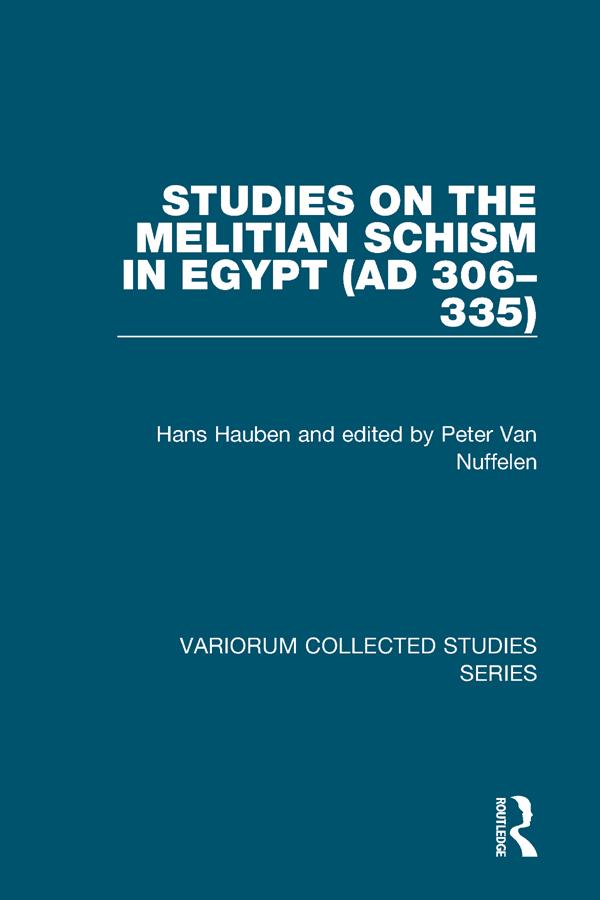
The Melitian schism originated in the context of the Diocletianic persecution. In 306, under dramatic circumstances, Melitius of Lycopolis decided to challenge his superior, the bishop of Alexandria. An attempt at reconciliation proposed by the Council of Nicaea (325) was unsuccessful, and the Melitians, as they were now called, often associated with the Arians, would become favourite targets of a bitter and polemical Athanasius of Alexandria (328-373). The schism continued to exist in Egypt until the middle of the eighth century. Notwithstanding the rich source material, including original documents and papyri, the dissidence has received relatively little scholarly attention. This collection of essays by Hans Hauben focuses on the well-documented earliest phase of the schism, from the persecution to the Synod of Tyre (335). It elucidates the chronology of the schism, the decisions of Nicaea, the internal organisation of the parallel church, and the tensions in Alexandria caused by its repression, as well as interpretative problems posed by the sources. The essays constitute an in-depth assessment of the causes, development and meaning of the Melitian schism, and together with additional, related studies also included in the volume they paint a rich picture of early Christian society.
Betal enkelt med kort, Klarna, Apple Pay eller Google Pay. Ikke fornøyd? Du har alltid 14 dagers angrerett. Les mer i våre vilkår. Har du spørsmål, send oss en e-post på hello@memmo.org.
Memmo gjør det enklere å studere – uansett hvor du er i verden. Hos oss samler du pensumbøker og smarte studieverktøy på ett og samme sted: sammendrag, quizer, podkaster og flashcards. Og så Ted, din studiekompis som svarer på alt du lurer på. Over 50 000 studenter studerer allerede her – bygget for at du skal lære raskere og stresse mindre.
Du vil kanskje også like
Kjøp boken0