
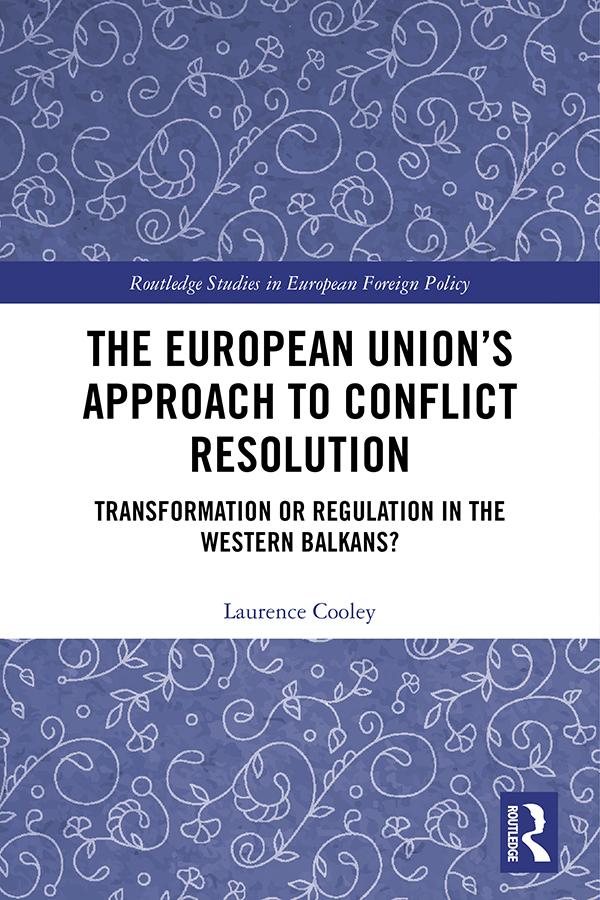
This book investigates and explains the European Union’s approach to conflict resolution in three countries of the Western Balkans: Bosnia and Herzegovina, Macedonia and Kosovo. In doing so, it critically interrogates claims that the EU acts as an agent of conflict transformation in its engagement with conflict-affected states. The book argues, contrary to the assumptions of much of the existing literature, that rather than seeking the transformation of conflicts, the EU pursues a more conservative strategy based on the regulation of conflict through the promotion of institutional mechanisms such as consociational power sharing and decentralisation.
Drawing on discourse analysis of documents, speeches, and interviews conducted by the author with European Union officials and policy-makers in Brussels and the case-study countries, the book offers a theoretically grounded, methodologically rigorous and empirically detailed analysis of EU policy preferences, of the ideas that underpin them, and of how those preferences are legitimised.
This book will be of key interest to scholars, students and practitioners interested in ethnic conflict and conflict resolution, the politics of the Balkans, and the external and foreign policies of the EU.
Betal enkelt med kort, Klarna, Apple Pay eller Google Pay. Ikke fornøyd? Du har alltid 14 dagers angrerett. Les mer i våre vilkår. Har du spørsmål, send oss en e-post på hello@memmo.org.
Memmo gjør det enklere å studere – uansett hvor du er i verden. Hos oss samler du pensumbøker og smarte studieverktøy på ett og samme sted: sammendrag, quizer, podkaster og flashcards. Og så Ted, din studiekompis som svarer på alt du lurer på. Over 50 000 studenter studerer allerede her – bygget for at du skal lære raskere og stresse mindre.