
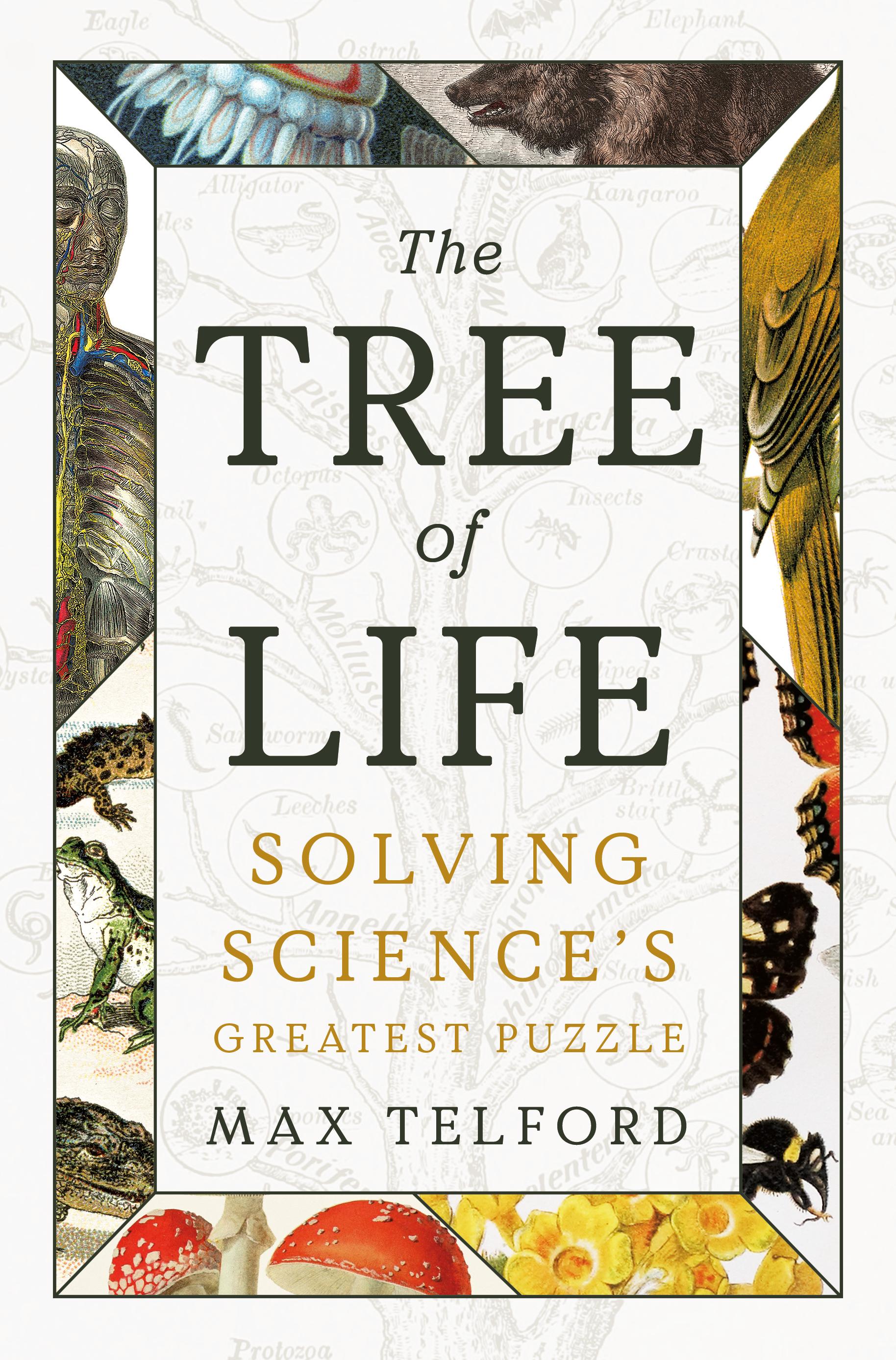
Taking readers inside one of science’s most ambitious projects, a leading evolutionary biologist offers a definitive portrait of life’s family tree.
Are humans really fish? Why are we the only animals with chins? How much of our DNA do we share with the trillions of bacteria in our bodies? For centuries, scientists have chased the secrets of how life on our planet arose, how it assumed its dazzling diversity of forms, and how we humans are related to everything else on earth. With increasingly sophisticated genetic methods now bringing us ever closer to answers, leading evolutionary biologist Max Telford takes us inside one of science’s greatest quests. In the intellectually thrilling The Tree of Life, Telford shows how reconstructing the web of relationships between all our planet’s species, from birds and butterflies to mushrooms and moose, allows us to unravel the epic history of life on our planet.
In Telford’s hands, the many-branched evolutionary trees that biologists assemble—from Charles Darwin’s first sketches to the vast computer-generated diagrams scientists are building today—become time machines that take us on a vivid journey through four billion years of life’s history. We meet long-lost ancestors, picturing them in the environment of a much younger earth, and discover where we first acquired our backbones and nipples and, conversely, where we lost our tails. We learn how insects are “actually” crustaceans, and how dogs and wolves are more closely related to whales than to the recently extinct Tasmanian wolves they so resemble. Far from a dry representation of the dead, the tree of life is a living, shifting thing that constantly alters our perspective on the past, present, and future of life on earth.
For any reader fascinated by evolution and natural history, The Tree of Life is an essential portal to the distant past and a window onto our collective origins.
Betal enkelt med kort, Klarna, Apple Pay eller Google Pay. Ikke fornøyd? Du har alltid 14 dagers angrerett. Les mer i våre vilkår. Har du spørsmål, send oss en e-post på hello@memmo.org.
Memmo gjør det enklere å studere – uansett hvor du er i verden. Hos oss samler du pensumbøker og smarte studieverktøy på ett og samme sted: sammendrag, quizer, podkaster og flashcards. Og så Ted, din studiekompis som svarer på alt du lurer på. Over 50 000 studenter studerer allerede her – bygget for at du skal lære raskere og stresse mindre.