
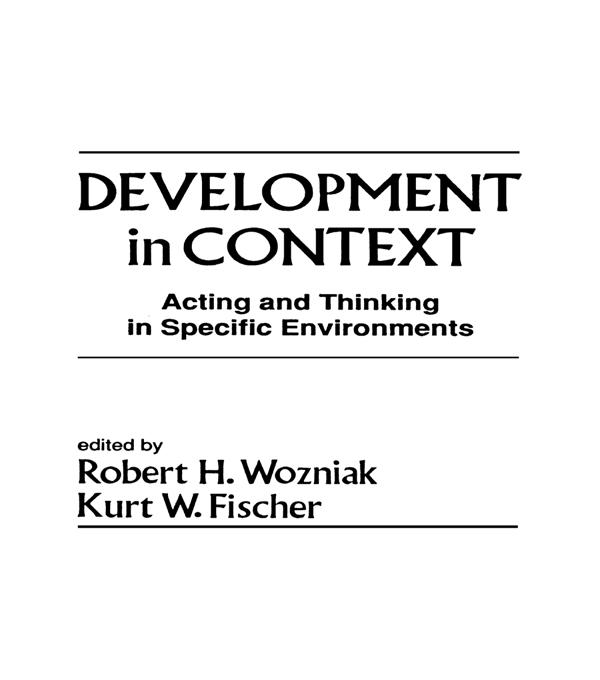
In this volume leading developmentalists address the question of how children's thinking develops in context by drawing on the theories of Vygotsky, Gibson, and Piaget.
Analyses of the ecology and the dynamics of behavior have become popular, emphasizing the particulars of people acting in specific environments and the many complex factors of human body and mind that contribute to action and thought. This volume brings together many of the current efforts to deal with development in this richly ecological, dynamic way.
The research reported demonstrates that recent years have produced major shifts in approach. Activities are studied as they naturally occur in everyday contexts. Children's active construction of the world around them is treated as fundamentally social in nature, occurring in families, with peers, and in cultures. Behavior is studied not as something disembodied but within a rich matrix of body, emotion, belief, value, and physical world. Behavior is analyzed as changing dynamically, not only over seconds and minutes, but over hours, days, and years.
Betal enkelt med kort, Klarna, Apple Pay eller Google Pay. Ikke fornøyd? Du har alltid 14 dagers angrerett. Les mer i våre vilkår. Har du spørsmål, send oss en e-post på hello@memmo.org.
Memmo gjør det enklere å studere – uansett hvor du er i verden. Hos oss samler du pensumbøker og smarte studieverktøy på ett og samme sted: sammendrag, quizer, podkaster og flashcards. Og så Ted, din studiekompis som svarer på alt du lurer på. Over 50 000 studenter studerer allerede her – bygget for at du skal lære raskere og stresse mindre.