
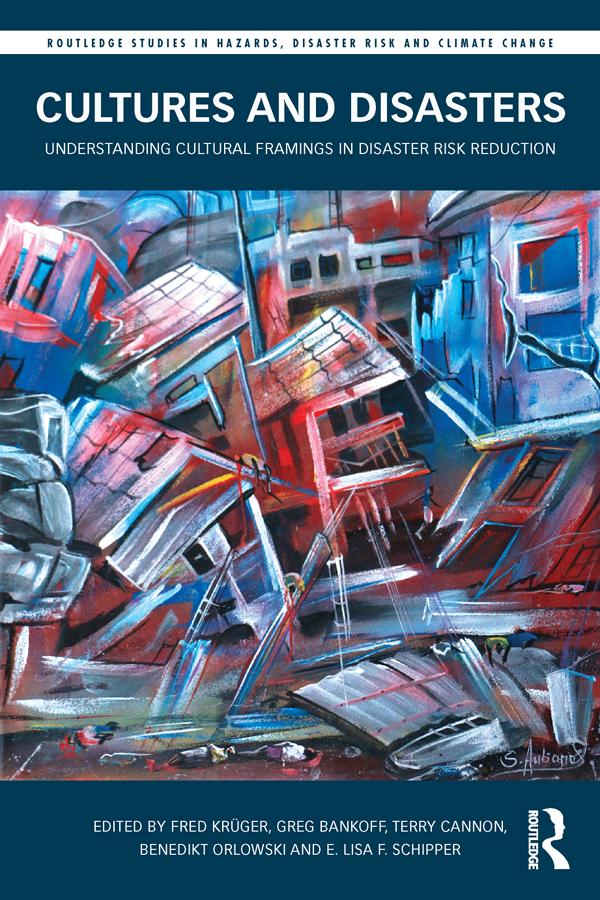
Why did the people of the Zambesi Delta affected by severe flooding return early to their homes or even choose to not evacuate? How is the forced resettlement of small-scale farmers living along the foothills of an active volcano on the Philippines impacting on their day-to-day livelihood routines? Making sense of such questions and observations is only possible by understanding how the decision-making of societies at risk is embedded in culture, and how intervention measures acknowledge, or neglect, cultural settings. The social construction of risk is being given increasing priority in understand how people experience and prioritize hazards in their own lives and how vulnerability can be reduced, and resilience increased, at a local level.
Culture and Disasters adopts an interdisciplinary approach to explore this cultural dimension of disaster, with contributions from leading international experts within the field. Section I provides discussion of theoretical considerations and practical research to better understand the important of culture in hazards and disasters. Culture can be interpreted widely with many different perspectives; this enables us to critically consider the cultural boundedness of research itself, as well as the complexities of incorporating various interpretations into DRR. If culture is omitted, related issues of adaptation, coping, intervention, knowledge and power relations cannot be fully grasped. Section II explores what aspects of culture shape resilience? How have people operationalized culture in every day life to establish DRR practice? What constitutes a resilient culture and what role does culture play in a society’s decision making? It is natural for people to seek refuge in tried and trust methods of disaster mitigation, however, culture and belief systems are constantly evolving. How these coping strategies can be introduced into DRR therefore poses a challenging question. Finally, Section III examines the effectiveness of key scientific frameworks for understanding the role of culture in disaster risk reduction and management. DRR includes a range of norms and breaking these through an understanding of cultural will challenge established theoretical and empirical frameworks.
Betal enkelt med kort, Klarna, Apple Pay eller Google Pay. Ikke fornøyd? Du har alltid 14 dagers angrerett. Les mer i våre vilkår. Har du spørsmål, send oss en e-post på hello@memmo.org.
Memmo gjør det enklere å studere – uansett hvor du er i verden. Hos oss samler du pensumbøker og smarte studieverktøy på ett og samme sted: sammendrag, quizer, podkaster og flashcards. Og så Ted, din studiekompis som svarer på alt du lurer på. Over 50 000 studenter studerer allerede her – bygget for at du skal lære raskere og stresse mindre.