
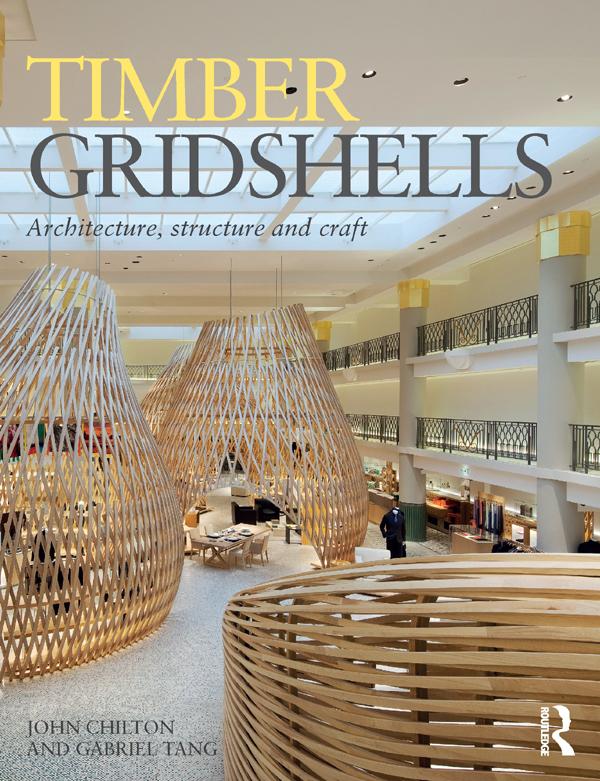
Throughout history, people have constructed simple timber lattice shelters such as the tepee or yurt, covered with animal skins, leaves, grasses and woven fabrics. Over the last fifty years, more sophisticated ‘webs of wood’ have emerged, with timber gridshells in particular becoming a structurally expressive form of architecture. Recent developments in digital design, 3-D modelling software, timber fabrication technologies as well as trends towards low-carbon construction have further reinforced architects’ interest in the use of lightweight timber grids and lattice structures.
This timely book charts the origin and evolution of the timber gridshell and its relation to timber lattice architecture. Drawing on a range of international case studies, the authors trace the effect advances in technology have had on design and construction in this field, providing a clear understanding of the structure, morphology, design process, and construction technology, and examining both the application and constraints of timber gridshells in architectural design.
Timber Gridshells is a highly illustrated, up-to-date resource which provides detailed answers and inspires new ideas. As such, it is essential reading for students of architecture as well as professional architects.
Betal enkelt med kort, Klarna, Apple Pay eller Google Pay. Ikke fornøyd? Du har alltid 14 dagers angrerett. Les mer i våre vilkår. Har du spørsmål, send oss en e-post på hello@memmo.org.
Memmo gjør det enklere å studere – uansett hvor du er i verden. Hos oss samler du pensumbøker og smarte studieverktøy på ett og samme sted: sammendrag, quizer, podkaster og flashcards. Og så Ted, din studiekompis som svarer på alt du lurer på. Over 50 000 studenter studerer allerede her – bygget for at du skal lære raskere og stresse mindre.