
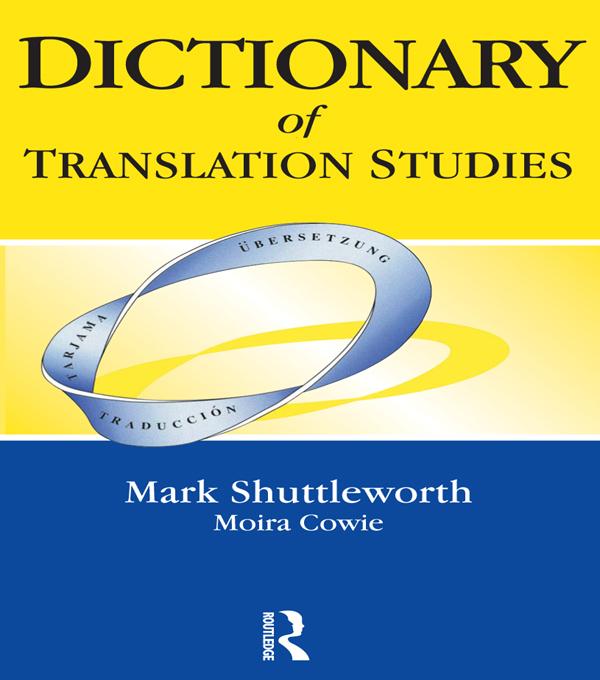
Published at a time of unprecedented growth of interest in translation, the Dictionary of Translation Studies aims to present the insights of a number of different approaches to translation in an unbiased, non-partisan way. With more than 300 articles, this essential volume provides the reader with a snapshot of a rapidly developing discipline, based on work produced in serveral languages.
With a clear, easy-to-follow layout, the Dictionary provides a comprehensive and highly accessible survey of key terms and concepts (such as Abusive Translation, Equivalence, Informationsangebot, Minimax Principle, Texteme and Thick Translation), types of activity (Autotranslation, Dubbing, Signed Language Interpreting), and schools and approaches (Leipzig School, Manipulation School, Nitra School).
Each term is presented within the context in which it first occurred and is given a definition which is both clear and informative. Major entries include a discussion of relevant viewpoints as well as comments on how the usage and application of the term have developed subsequent to its coining. In addition, all entries provide suggestions for further reading, and there is an extensive bibliography included at the end.
This is an indispensable tool for anyone studying or teaching translation at university level.
Betal enkelt med kort, Klarna, Apple Pay eller Google Pay. Ikke fornøyd? Du har alltid 14 dagers angrerett. Les mer i våre vilkår. Har du spørsmål, send oss en e-post på hello@memmo.org.
Memmo gjør det enklere å studere – uansett hvor du er i verden. Hos oss samler du pensumbøker og smarte studieverktøy på ett og samme sted: sammendrag, quizer, podkaster og flashcards. Og så Ted, din studiekompis som svarer på alt du lurer på. Over 50 000 studenter studerer allerede her – bygget for at du skal lære raskere og stresse mindre.