
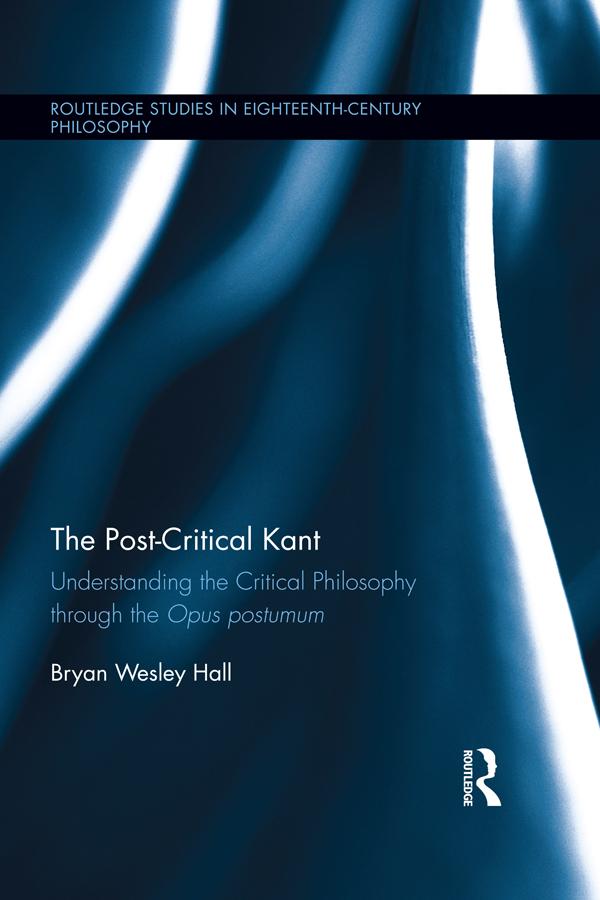
In this book, Bryan Wesley Hall breaks new ground in Kant scholarship, exploring the gap in Kant’s Critical philosophy in relation to his post-Critical work by turning to Kant’s final, unpublished work, the so-called Opus Postumum. Although Kant considered this project to be the "keystone" of his philosophical efforts, it has been largely neglected by scholars. Hall argues that only by understanding the Opus Postumum can we fully comprehend both Kant’s mature view as well as his Critical project.
In letters from 1798, Kant claims to have discovered a "gap" in the Critical philosophy that requires effecting a "transition from the metaphysical foundations of natural science to physics"; unfortunately, Kant does not make clear exactly what this gap is or how the transition is supposed to fill the gap. To resolve these issues, Hall draws on the Opus Postumum, arguing that Kant’s transition project can solve certain perennial problems with the Critical philosophy. This volume provides a powerful alternative to all current interpretations of the Opus Postumum, arguing that Kant’s transition project is best seen as the post-Critical culmination of his Critical philosophy. Hall carefully examines the deep connections between the Opus Postumum and the view Kant develops in the Critique of Pure Reason, to suggest that properly understanding the post-Critical Kant will significantly revise our view of Kant’s Critical period.
Betal enkelt med kort, Klarna, Apple Pay eller Google Pay. Ikke fornøyd? Du har alltid 14 dagers angrerett. Les mer i våre vilkår. Har du spørsmål, send oss en e-post på hello@memmo.org.
Memmo gjør det enklere å studere – uansett hvor du er i verden. Hos oss samler du pensumbøker og smarte studieverktøy på ett og samme sted: sammendrag, quizer, podkaster og flashcards. Og så Ted, din studiekompis som svarer på alt du lurer på. Over 50 000 studenter studerer allerede her – bygget for at du skal lære raskere og stresse mindre.