
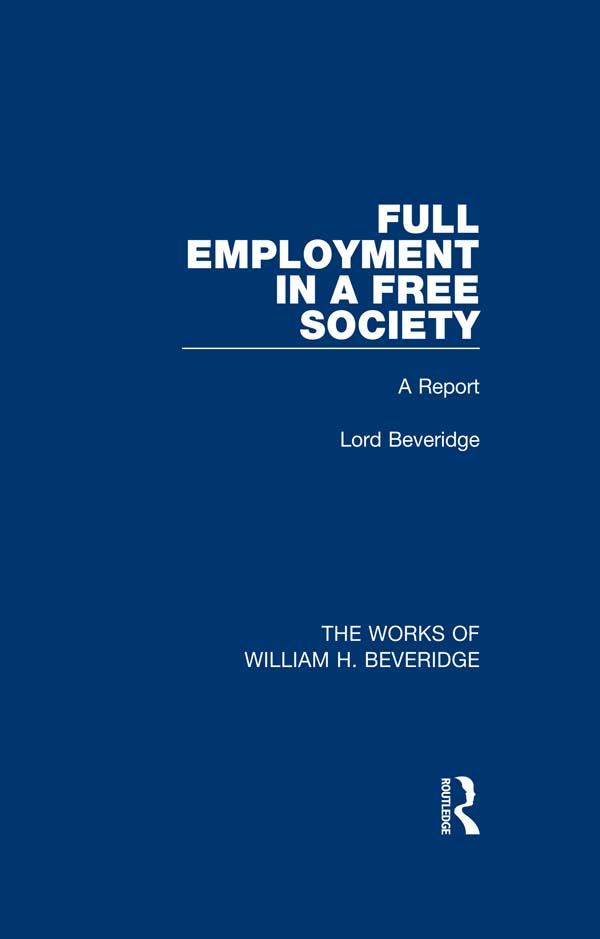
Beveridge defined full employment as a state where there are slightly more vacant jobs than there are available workers, or not more than 3% of the total workforce. This book discusses how this goal might be achieved, beginning with the thesis that because individual employers are not capable of creating full employment, it must be the responsibility of the state. Beveridge claimed that the upward pressure on wages, due to the increased bargaining strength of labour, would be eased by rising productivity, and kept in check by a system of wage arbitration. The cooperation of workers would be secured by the common interest in the ideal of full employment. Alternative measures for achieving full employment included Keynesian-style fiscal regulation, direct control of manpower, and state control of the means of production. The impetus behind Beveridge's thinking was social justice and the creation of an ideal new society after the war.
The book was written in the context of an economy which would have to transfer from wartime direction to peace time. It was then updated in 1960, following a decade where the average unemployment rate in Britain was in fact nearly 1.5%.
Betal enkelt med kort, Klarna, Apple Pay eller Google Pay. Ikke fornøyd? Du har alltid 14 dagers angrerett. Les mer i våre vilkår. Har du spørsmål, send oss en e-post på hello@memmo.org.
Memmo gjør det enklere å studere – uansett hvor du er i verden. Hos oss samler du pensumbøker og smarte studieverktøy på ett og samme sted: sammendrag, quizer, podkaster og flashcards. Og så Ted, din studiekompis som svarer på alt du lurer på. Over 50 000 studenter studerer allerede her – bygget for at du skal lære raskere og stresse mindre.