
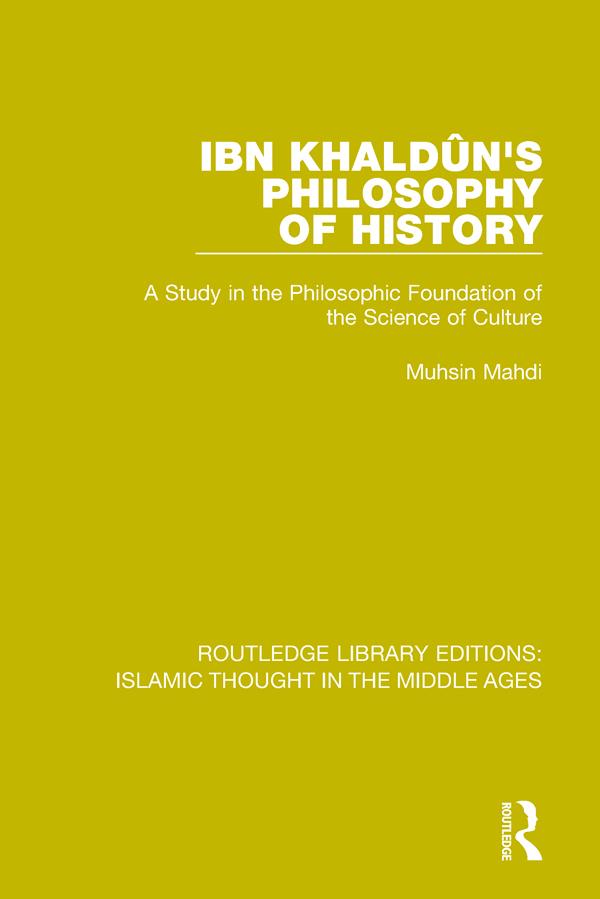
This book, first published in 1957, is the study of 14th-century Arab historian Ibn Khaldun, who founded a special science to consider history and culture, based on the philosophy of Plato and Aristotle and their Muslim followers. In no other field has the revolt of modern Western thought against traditional philosophy been so far-reaching in its consequences as in the field of history. Ibn Khaldun realized that history is more immediately related to action than political philosophy because it studies the actual state of man and society. He found that the ancients had not made history the object of an independent science, and thought it was important to fill this gap. A factual acquaintance with the conclusions of Ibn Khaldun’s reflections on history is not the same as the full comprehension of their theoretical significance. When these fundamental questions are answered, it becomes possible to pose the specific question of the relation of Ibn Khaldun’s philosophy of history, or his new science of culture, to other practical sciences and, particularly, to the art of history. After an exposition of the major trends of Islamic historiography, part of this book attempts to answer this question through the analysis of the method and intention of the sections of the ‘History’ where Ibn Khaldun himself examines the works of major Muslim historians, shows the necessity of the new science of culture, and distinguishes it from other practical sciences.
Betal enkelt med kort, Klarna, Apple Pay eller Google Pay. Ikke fornøyd? Du har alltid 14 dagers angrerett. Les mer i våre vilkår. Har du spørsmål, send oss en e-post på hello@memmo.org.
Memmo gjør det enklere å studere – uansett hvor du er i verden. Hos oss samler du pensumbøker og smarte studieverktøy på ett og samme sted: sammendrag, quizer, podkaster og flashcards. Og så Ted, din studiekompis som svarer på alt du lurer på. Over 50 000 studenter studerer allerede her – bygget for at du skal lære raskere og stresse mindre.