
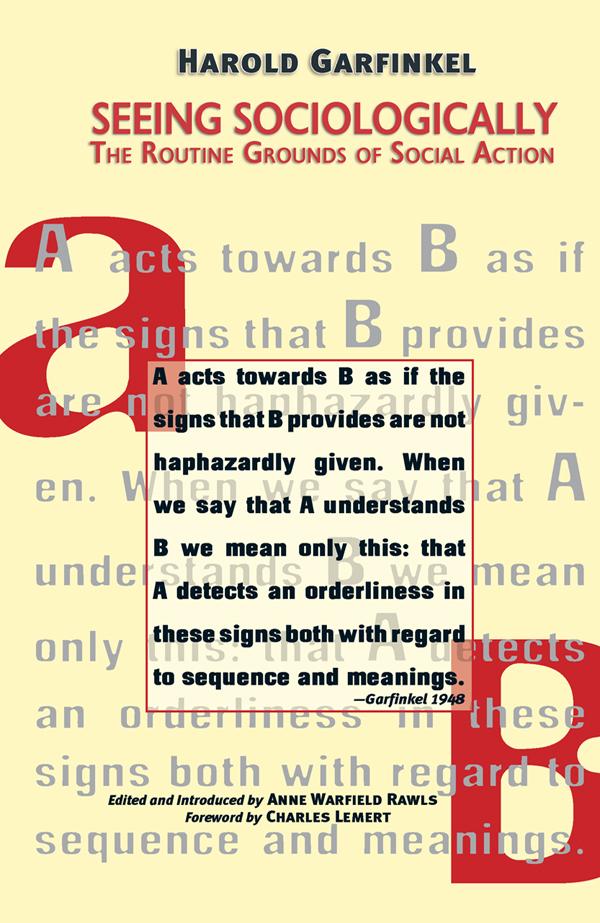
This book-never before published-is eminent sociologist Harold Garfinkel's earliest attempt, while at Harvard in 1948, to bridge the growing gap in American sociology. This gap was generated by a Parsonian paradigm that emphasised a scientific approach to sociological description, one that increasingly distanced itself from social phenomena in the increasingly influential ways studied by phenomenologists. It was Garfinkel's idea that phenomenological description, rendered in more empirical and interactive terms, might remedy shortcomings in the reigning Parsonian view. Garfinkel soon gave up the attempt to repair scientific description, and his focus became increasingly empirical until, in 1954, he famously coined the term "Ethnomethodology." However, in this early manuscript can be seen more clearly than in some of his later work the struggle with a conceptual and positivist rendering of social relations that ultimately informed Garfinkel's position. Here we find the sources of his turn toward ethnomethodology, which would influence subsequent generations of sociologists. Essential reading for all social theory scholars and graduate students and for a wider range of social scientists in anthropology, ethnomethodology, and other fields.
Betal enkelt med kort, Klarna, Apple Pay eller Google Pay. Ikke fornøyd? Du har alltid 14 dagers angrerett. Les mer i våre vilkår. Har du spørsmål, send oss en e-post på hello@memmo.org.
Memmo gjør det enklere å studere – uansett hvor du er i verden. Hos oss samler du pensumbøker og smarte studieverktøy på ett og samme sted: sammendrag, quizer, podkaster og flashcards. Og så Ted, din studiekompis som svarer på alt du lurer på. Over 50 000 studenter studerer allerede her – bygget for at du skal lære raskere og stresse mindre.
Du vil kanskje også like
Kjøp boken0