
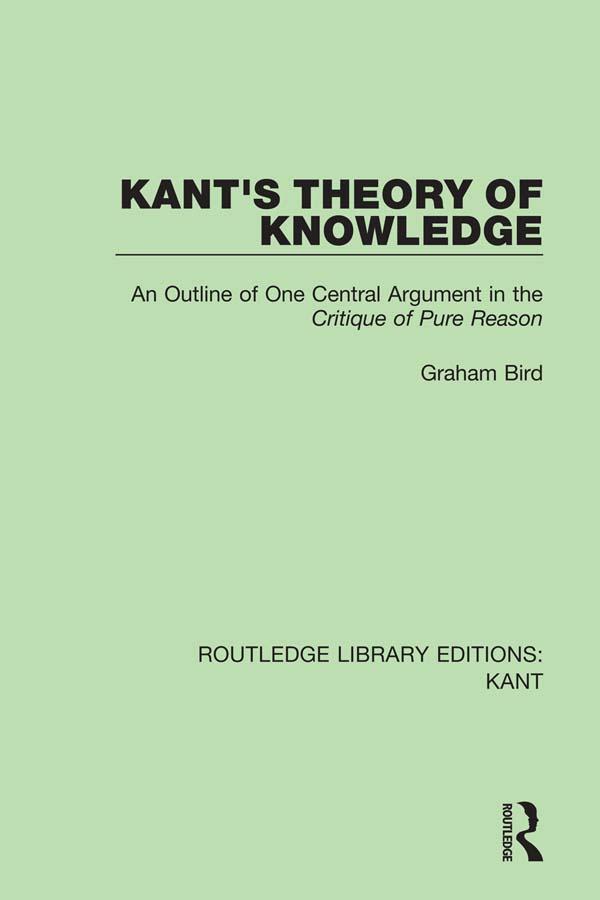
First published in 1962. Kant’s philosophical works, and especially the Critique of Pure Reason, have had some influence on recent British philosophy. But the complexities of Kant’s arguments, and the unfamiliarity of his vocabulary, inhibit understanding of his point of view. In Kant’s Theory of Knowledge an attempt is made to relate Kant’s arguments in the Critique of Pure Reason to contemporary issues by expressing them in a more modern idiom.
The selection of issues discussed is intended to present a continuous argument, of an epistemological kind, which runs centrally through the Critique. The argument deals with essentially with the problems, raised in the Transcendental Analytic, about the status of categories. It deals with certain preliminary assumptions made in setting these problems, and discusses the way in which the various sections of the Analytic contribute to their solution. It also deals with Kant’s criticisms of traditional metaphysics, and ends with an account of his effort in the Third Antinomy to resolve the conflict between freedom and causality, and so to effect a transition of knowledge to moral philosophy.
Betal enkelt med kort, Klarna, Apple Pay eller Google Pay. Ikke fornøyd? Du har alltid 14 dagers angrerett. Les mer i våre vilkår. Har du spørsmål, send oss en e-post på hello@memmo.org.
Memmo gjør det enklere å studere – uansett hvor du er i verden. Hos oss samler du pensumbøker og smarte studieverktøy på ett og samme sted: sammendrag, quizer, podkaster og flashcards. Og så Ted, din studiekompis som svarer på alt du lurer på. Over 50 000 studenter studerer allerede her – bygget for at du skal lære raskere og stresse mindre.