
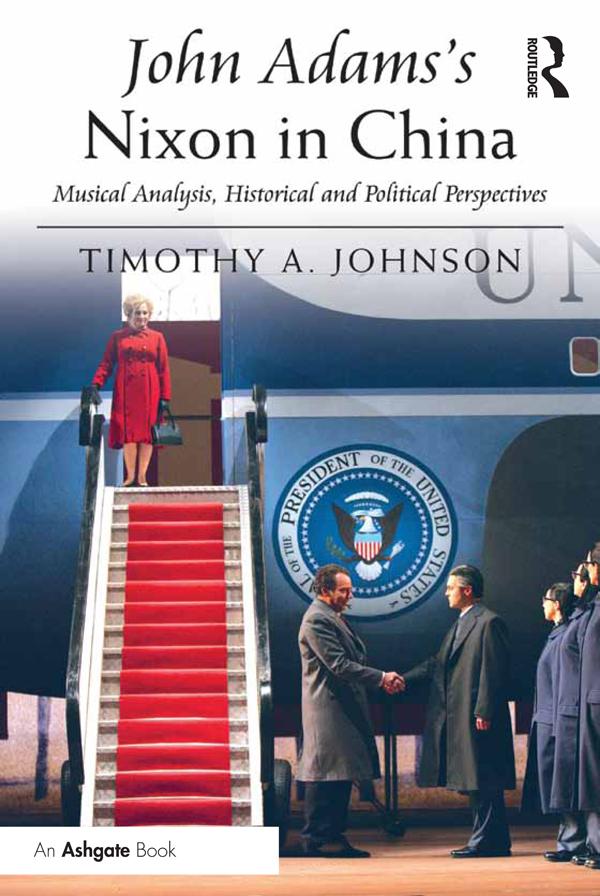
John Adams's opera, Nixon in China, is one of the most frequently performed operas in the contemporary literature. Timothy A. Johnson illuminates the opera and enhances listeners' and scholars' appreciation for this landmark work. This music-analytical guide presents a detailed, in-depth analysis of the music tied to historical and political contexts. The opera captures an important moment in history and in international relations, and a close study of it from an interdisciplinary perspective provides fresh, compelling insights about the opera. The music analysis takes a neo-Riemannian approach to harmony and to large-scale harmonic connections. Musical metaphors drawn between harmonies and their dramatic contexts enrich this approach. Motivic analysis reveals interweaving associations between the characters, based on melodic content. Analysis of rhythm and meter focuses on Adams's frequent use of grouping and displacement dissonances to propel the music forward or to illustrate the libretto. The book shows how the historical depiction in the opera is accurate, yet enriched by this operatic adaptation. The language of the opera is true to its source, but more evocative than the words spoken in 1972-due to Alice Goodman's marvelous, poetic libretto. And the music transcends its repetitive shell to become a hierarchically-rich and musically-compelling achievement.
Betal enkelt med kort, Klarna, Apple Pay eller Google Pay. Ikke fornøyd? Du har alltid 14 dagers angrerett. Les mer i våre vilkår. Har du spørsmål, send oss en e-post på hello@memmo.org.
Memmo gjør det enklere å studere – uansett hvor du er i verden. Hos oss samler du pensumbøker og smarte studieverktøy på ett og samme sted: sammendrag, quizer, podkaster og flashcards. Og så Ted, din studiekompis som svarer på alt du lurer på. Over 50 000 studenter studerer allerede her – bygget for at du skal lære raskere og stresse mindre.
Du vil kanskje også like
Kjøp boken0